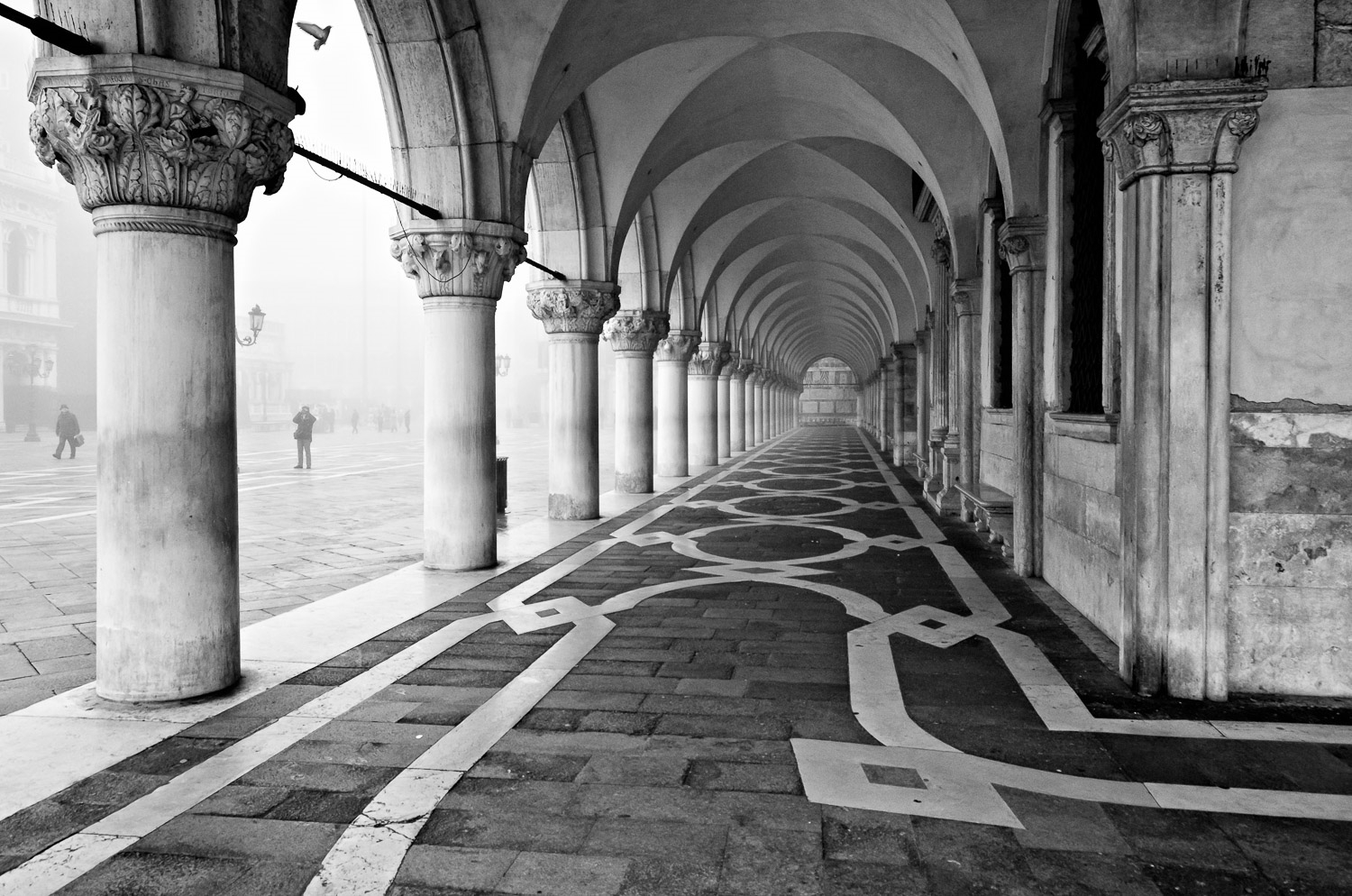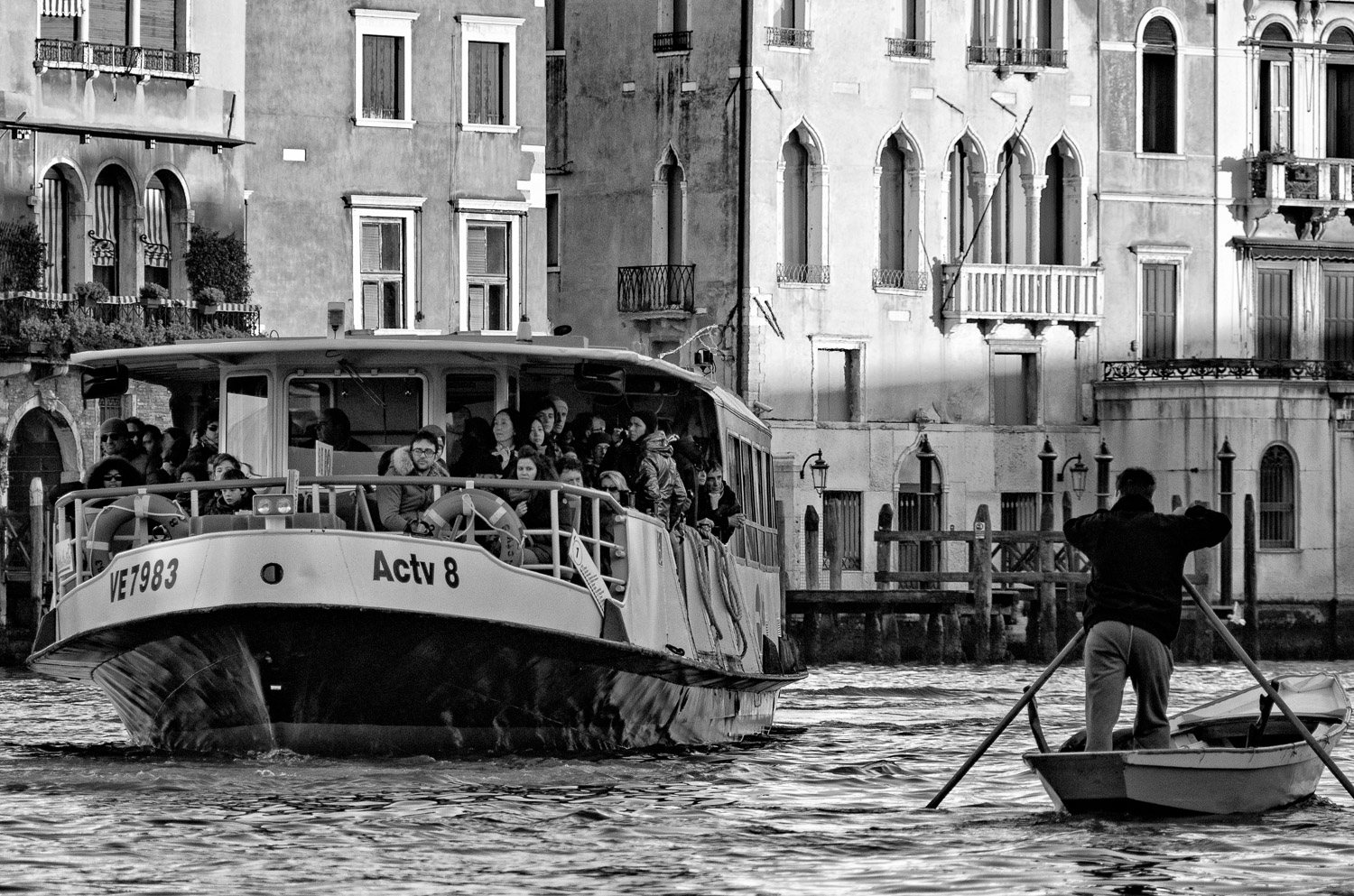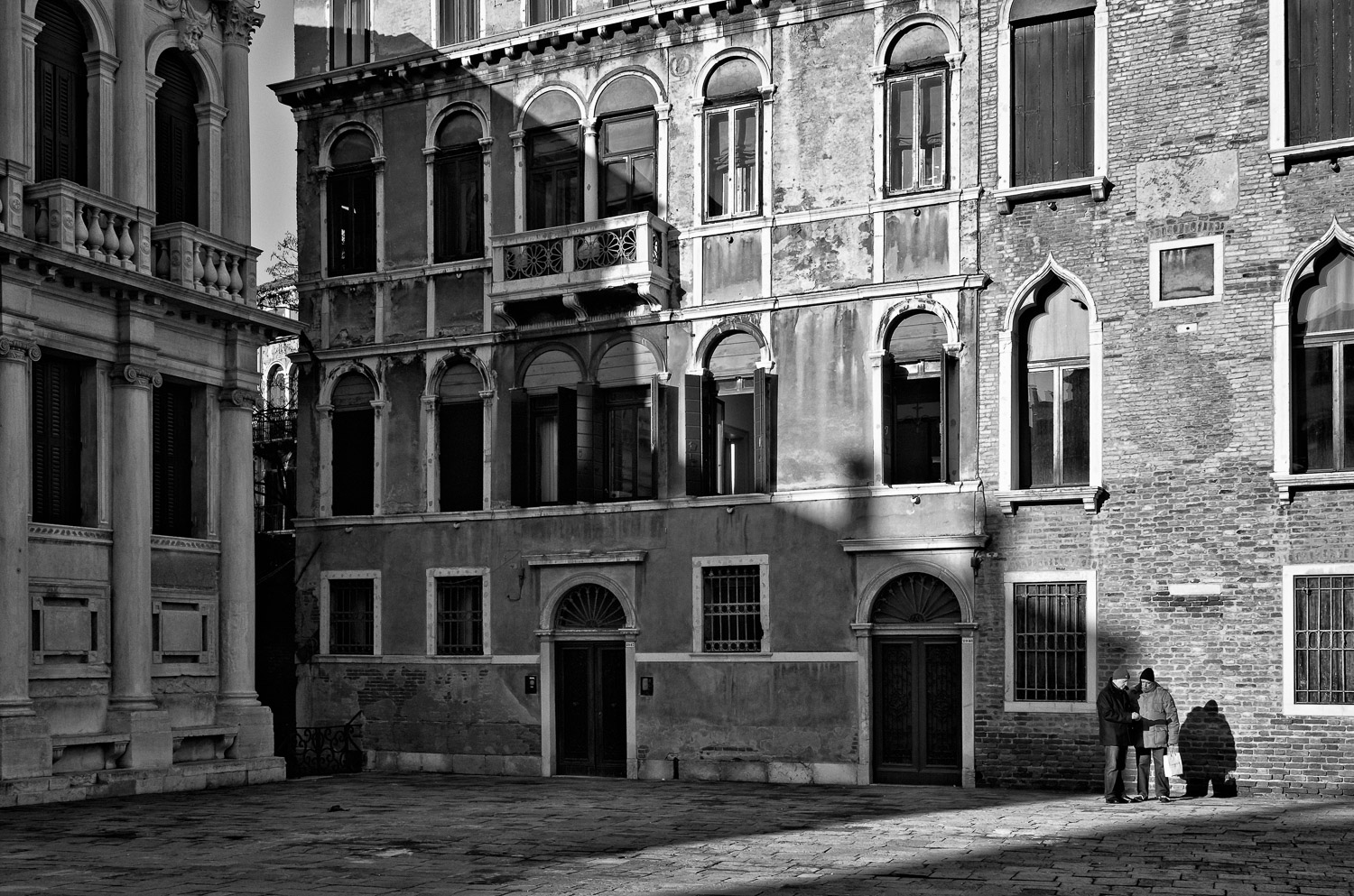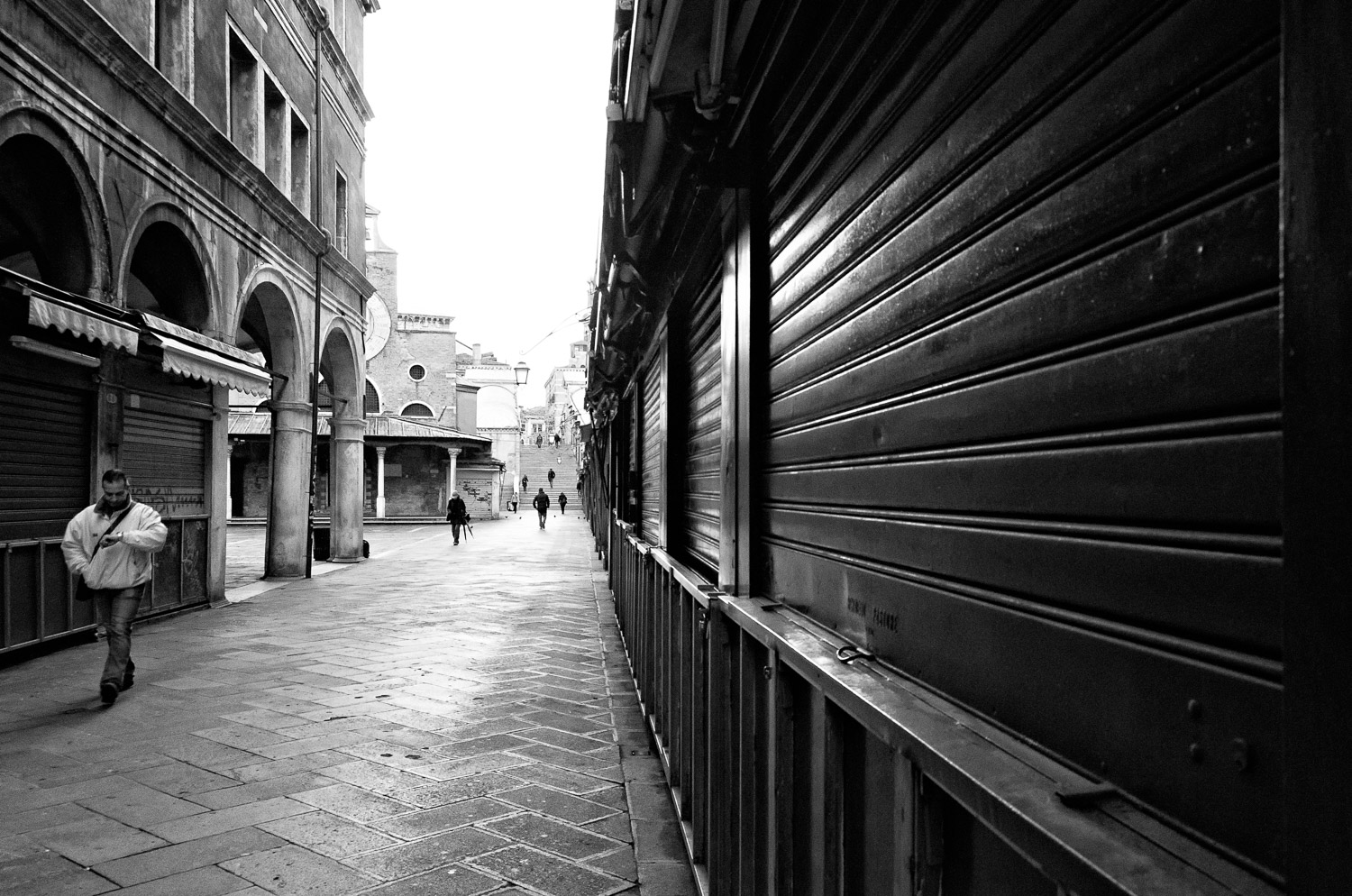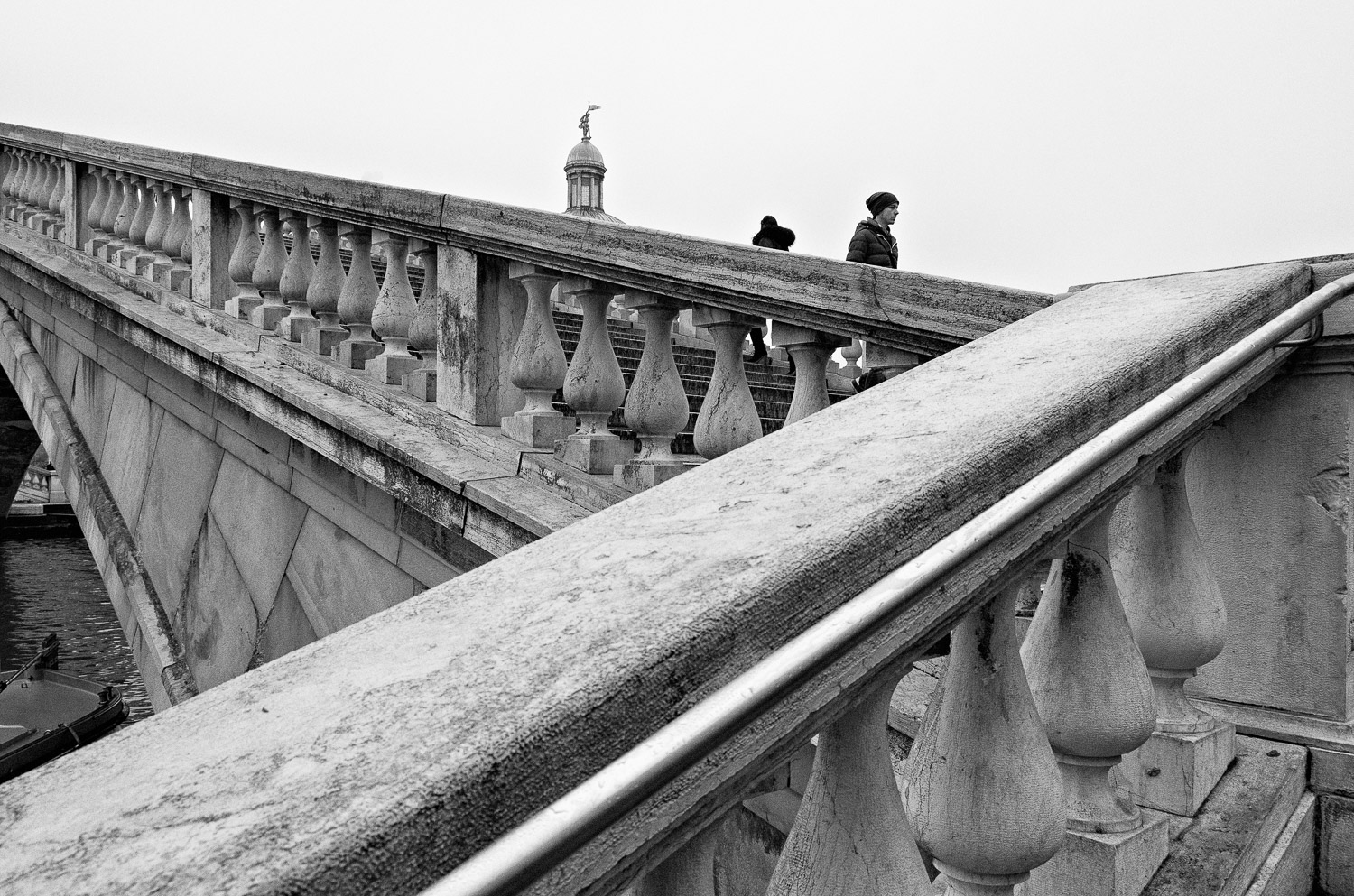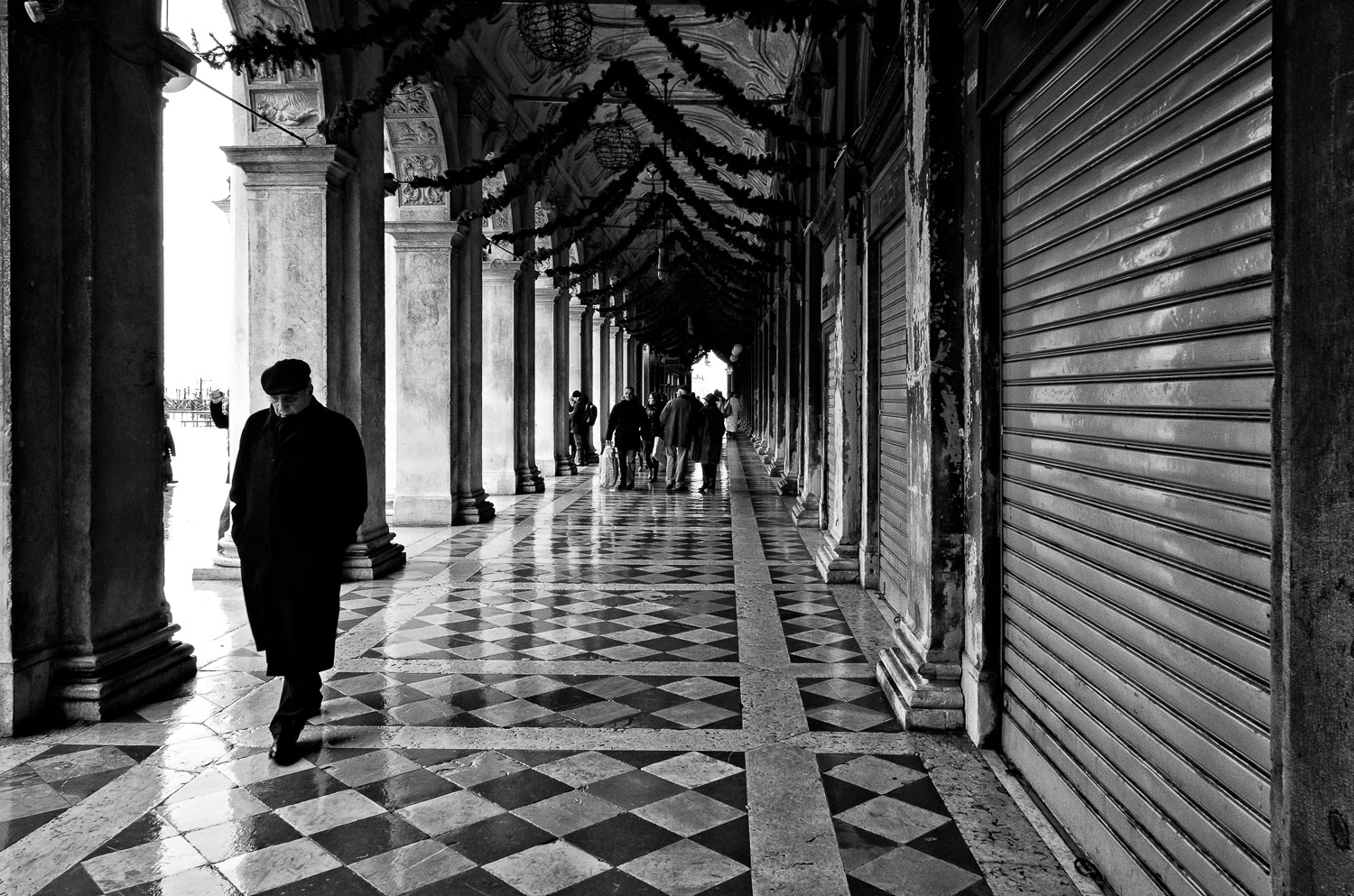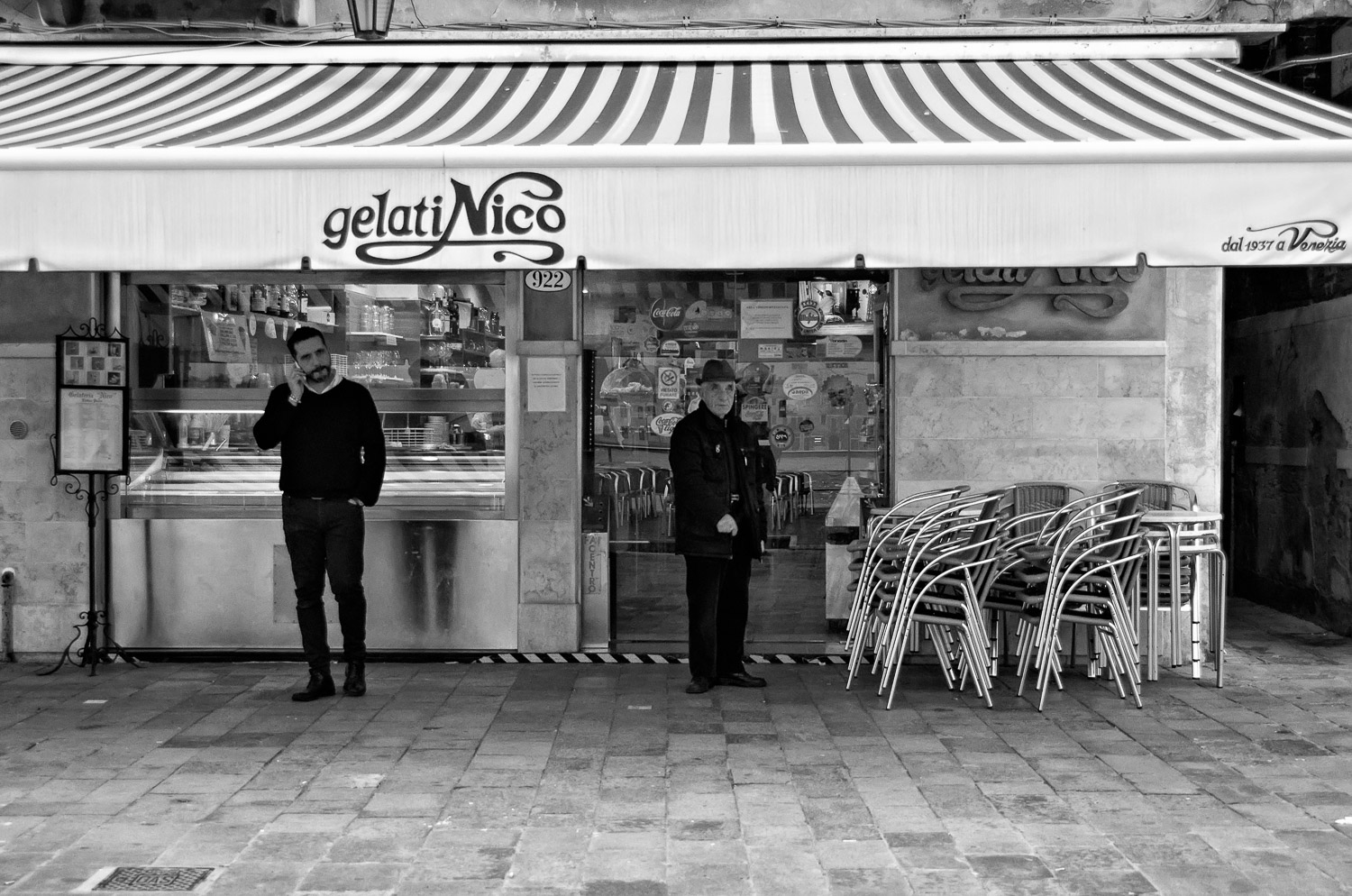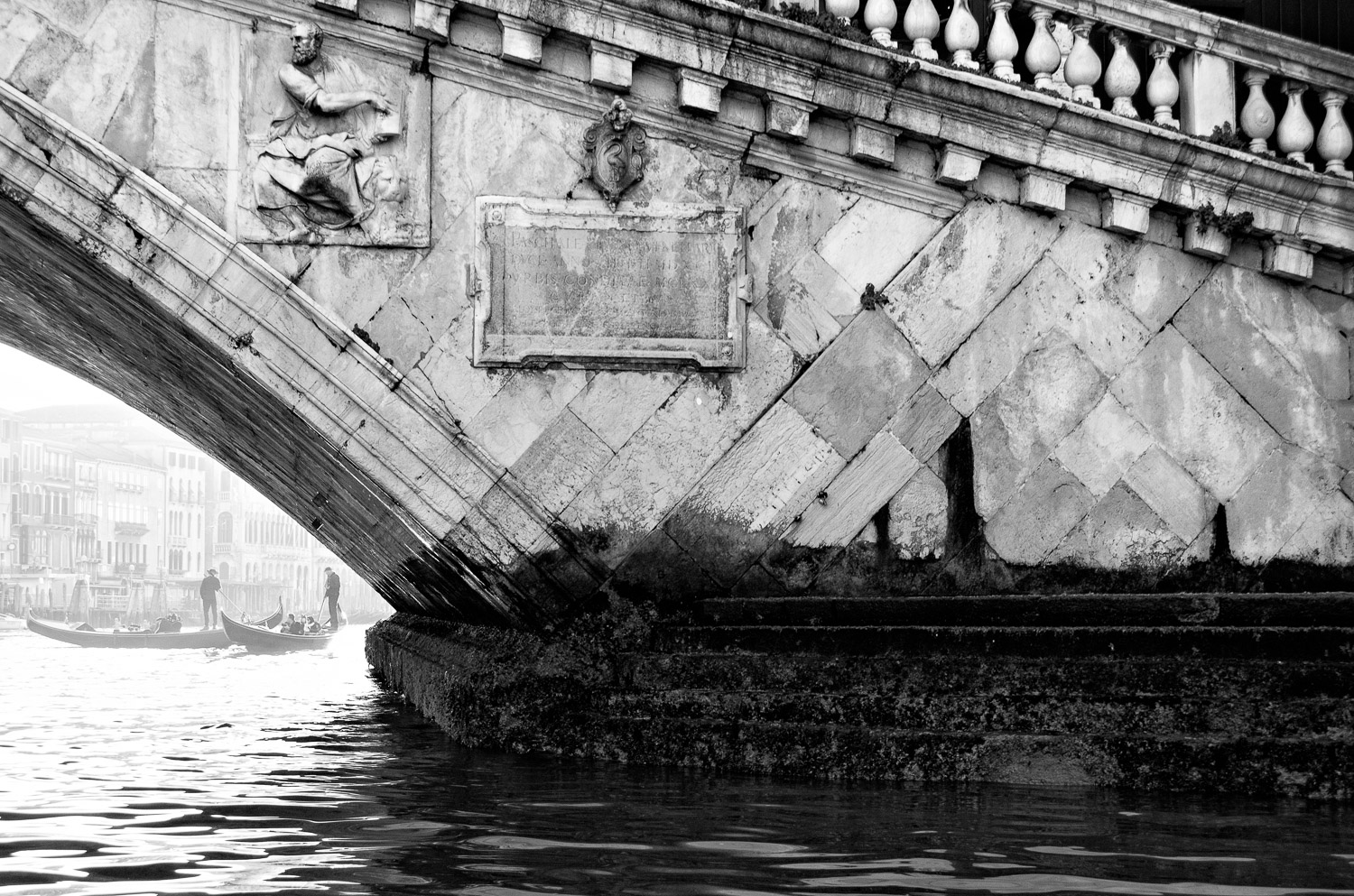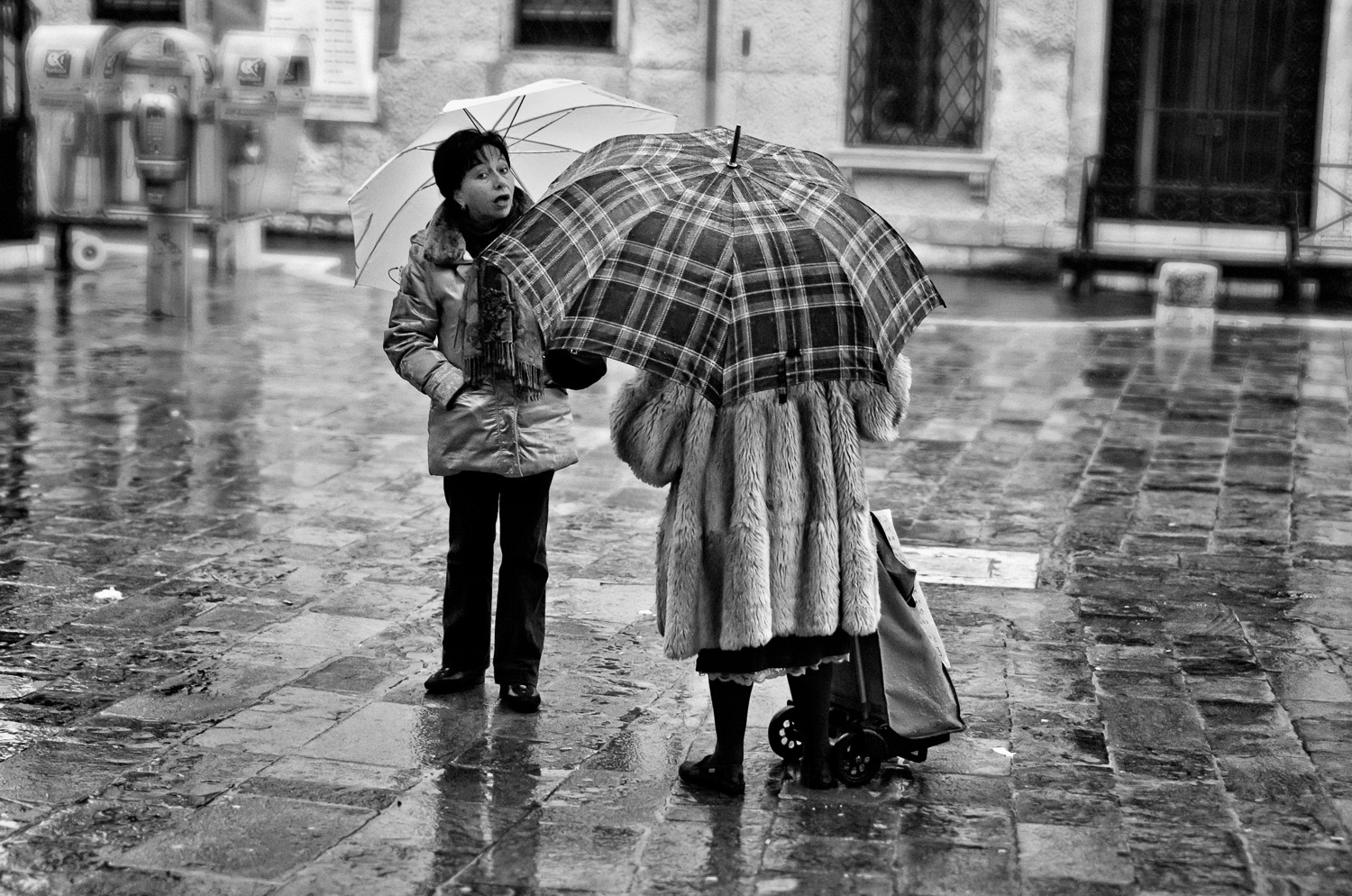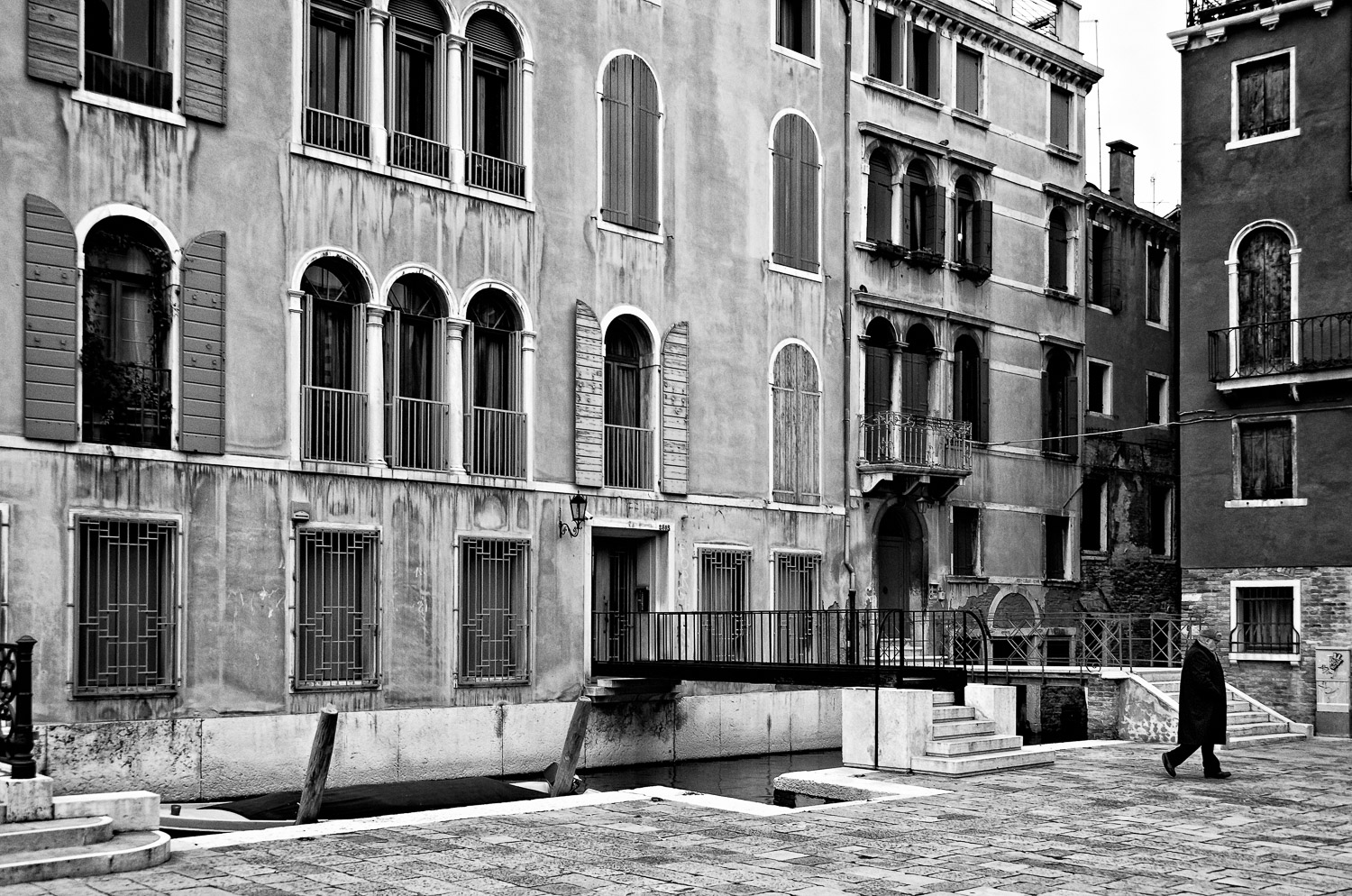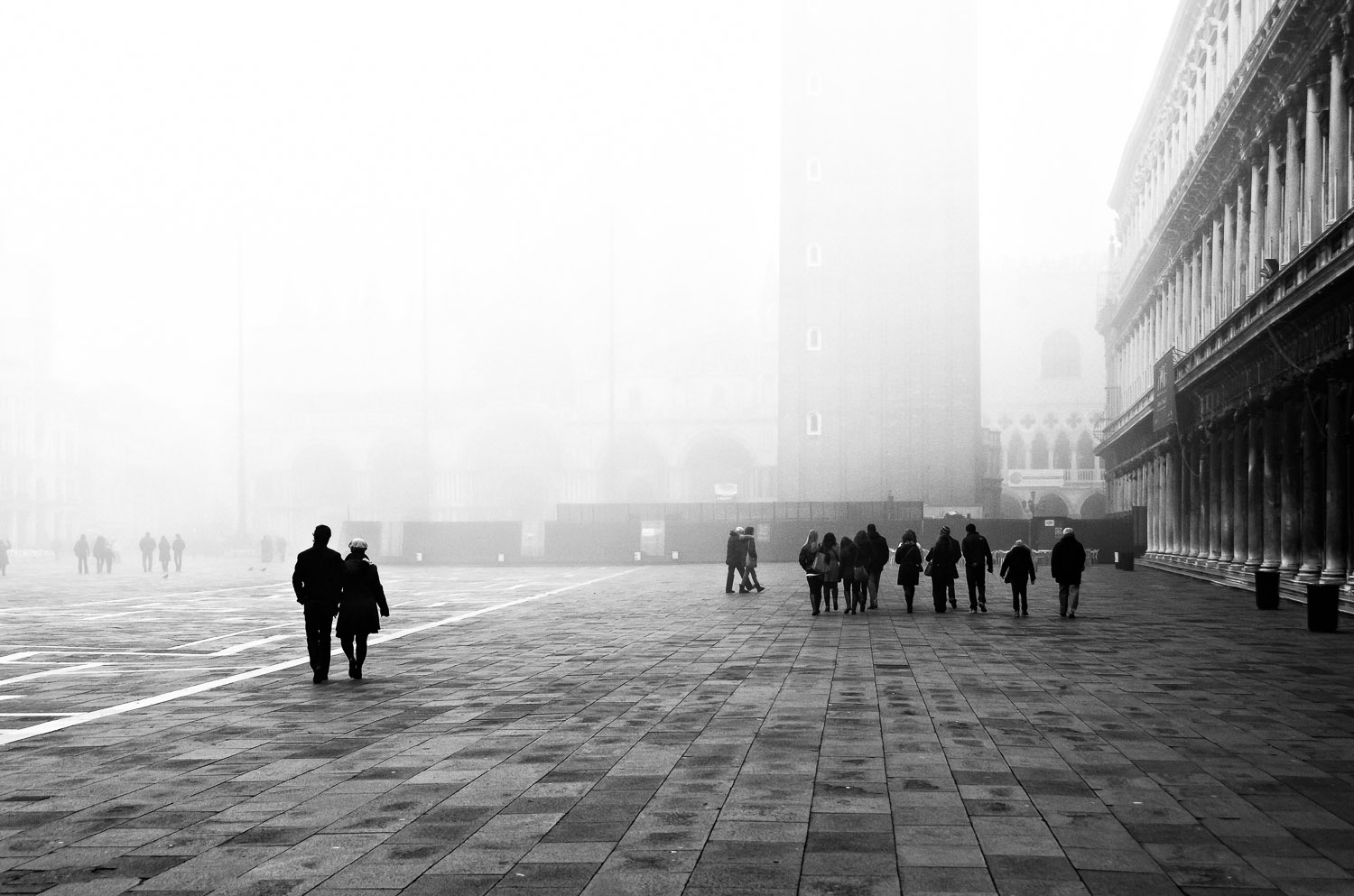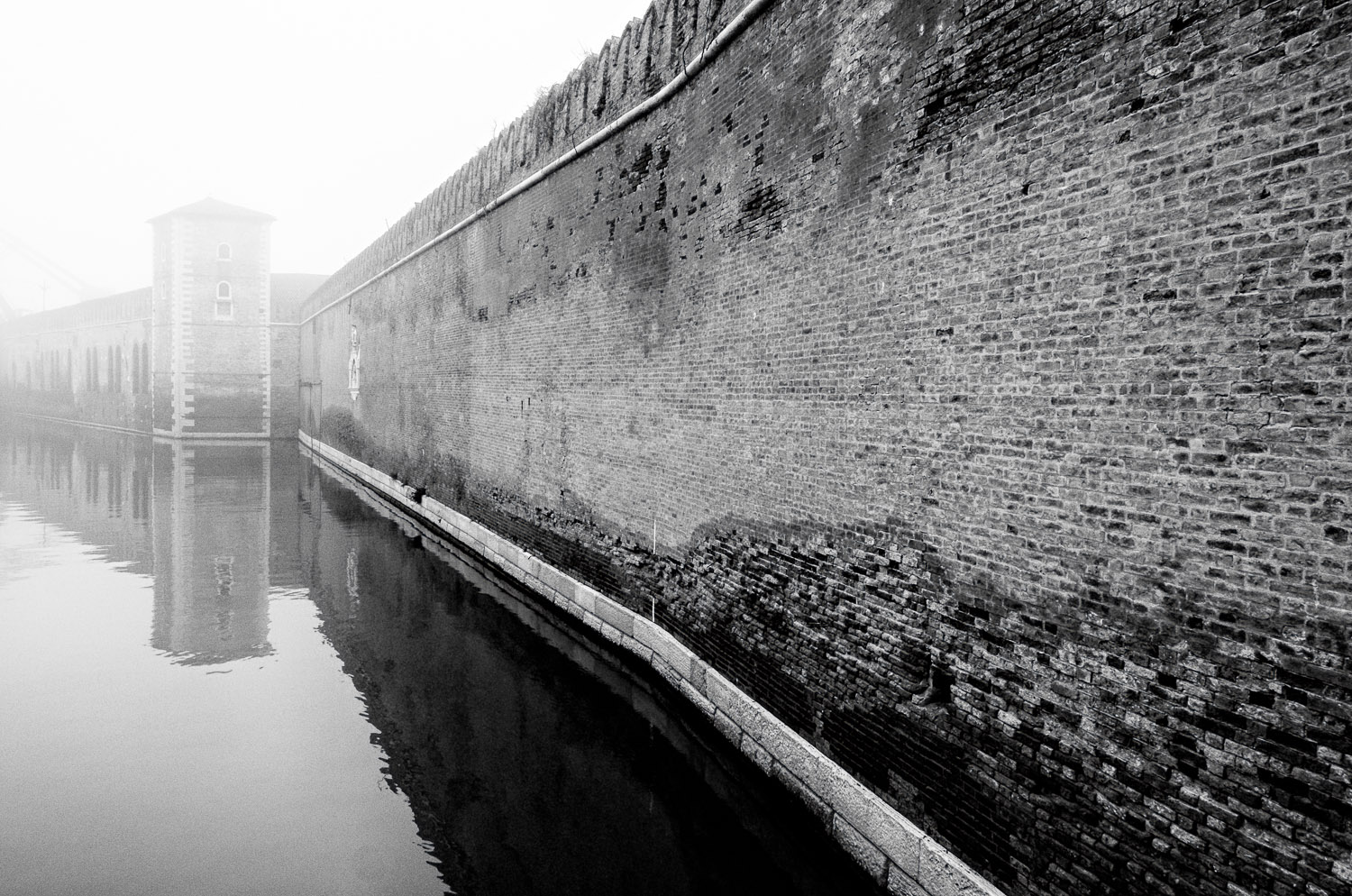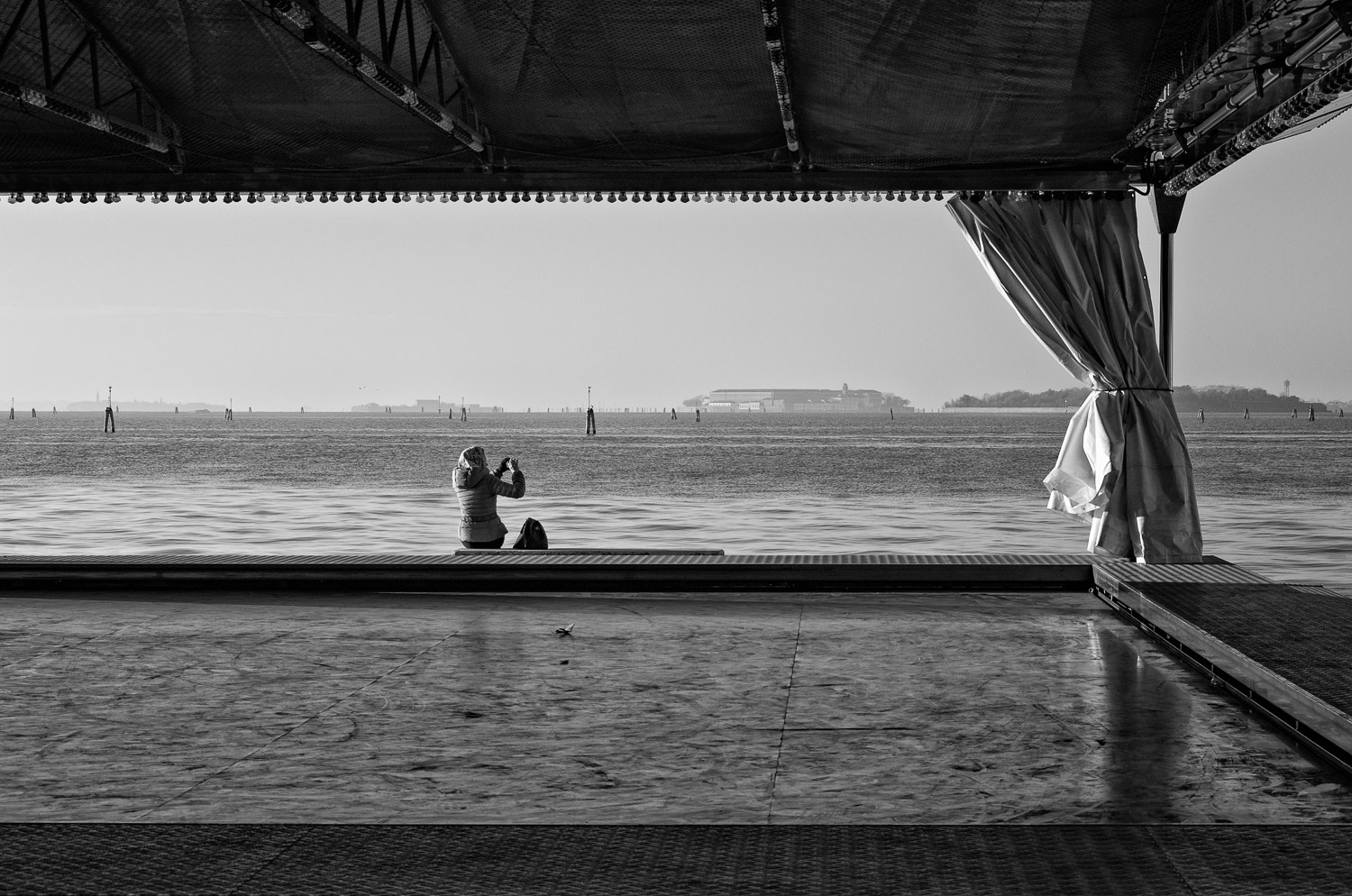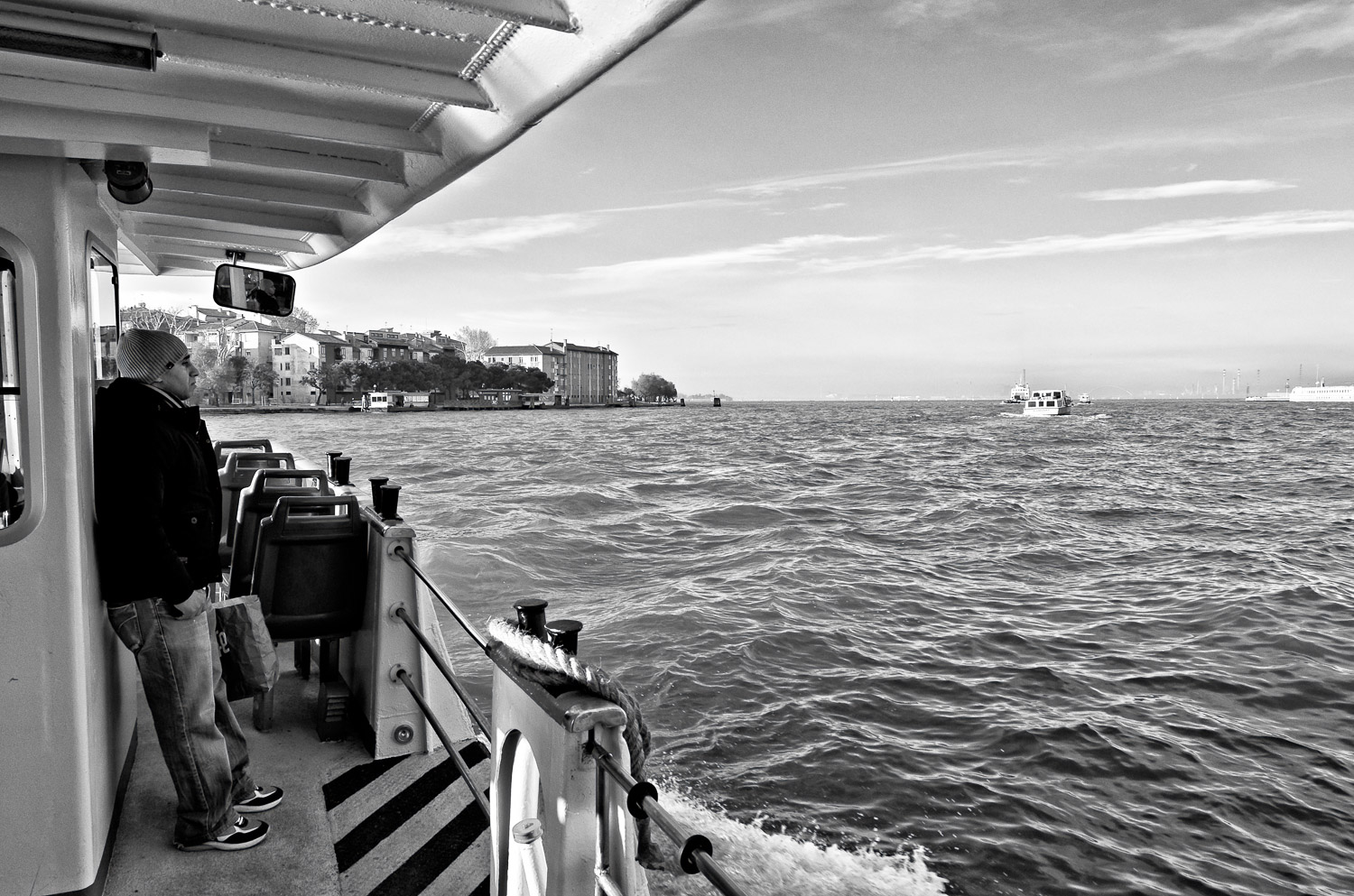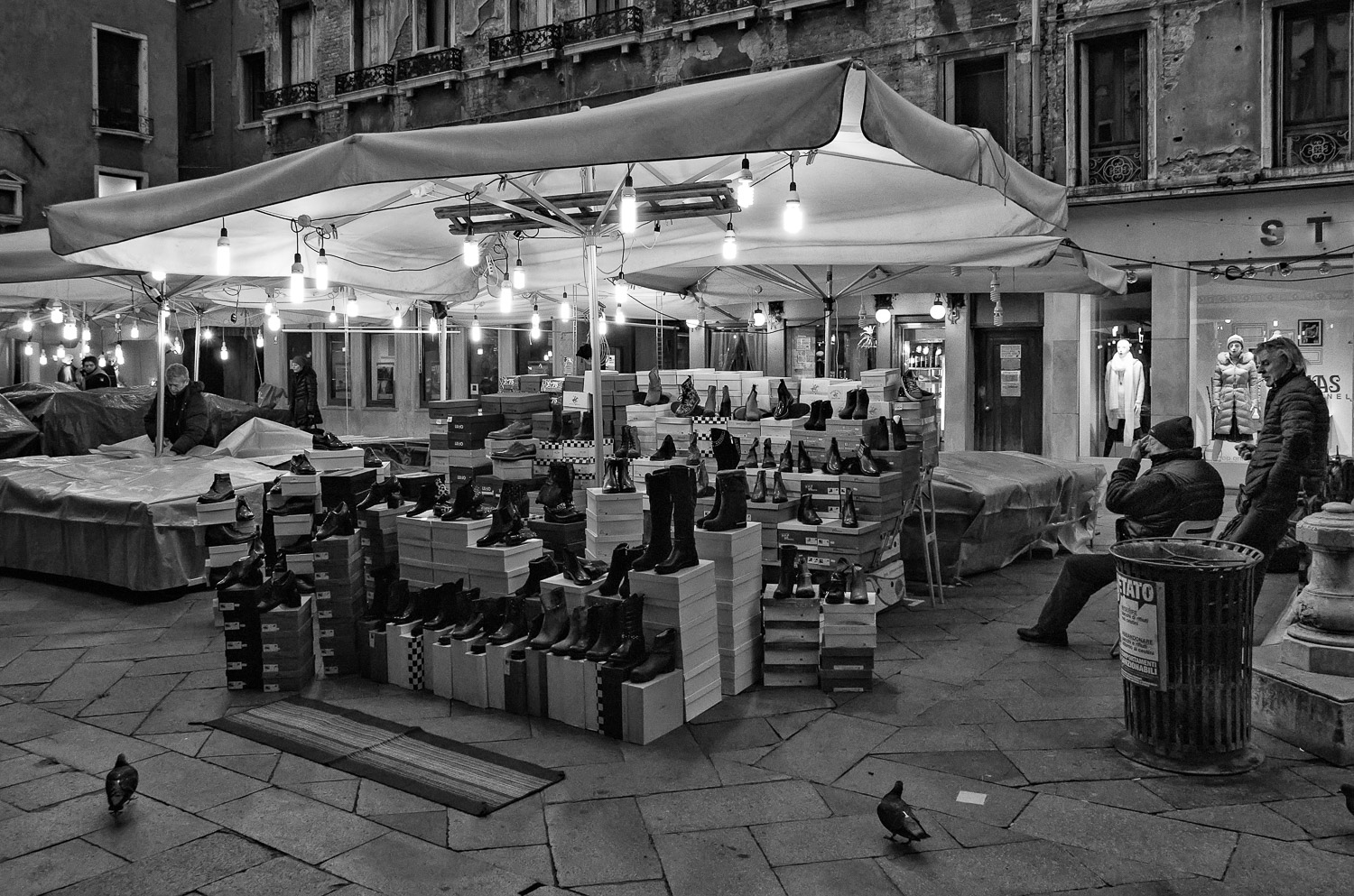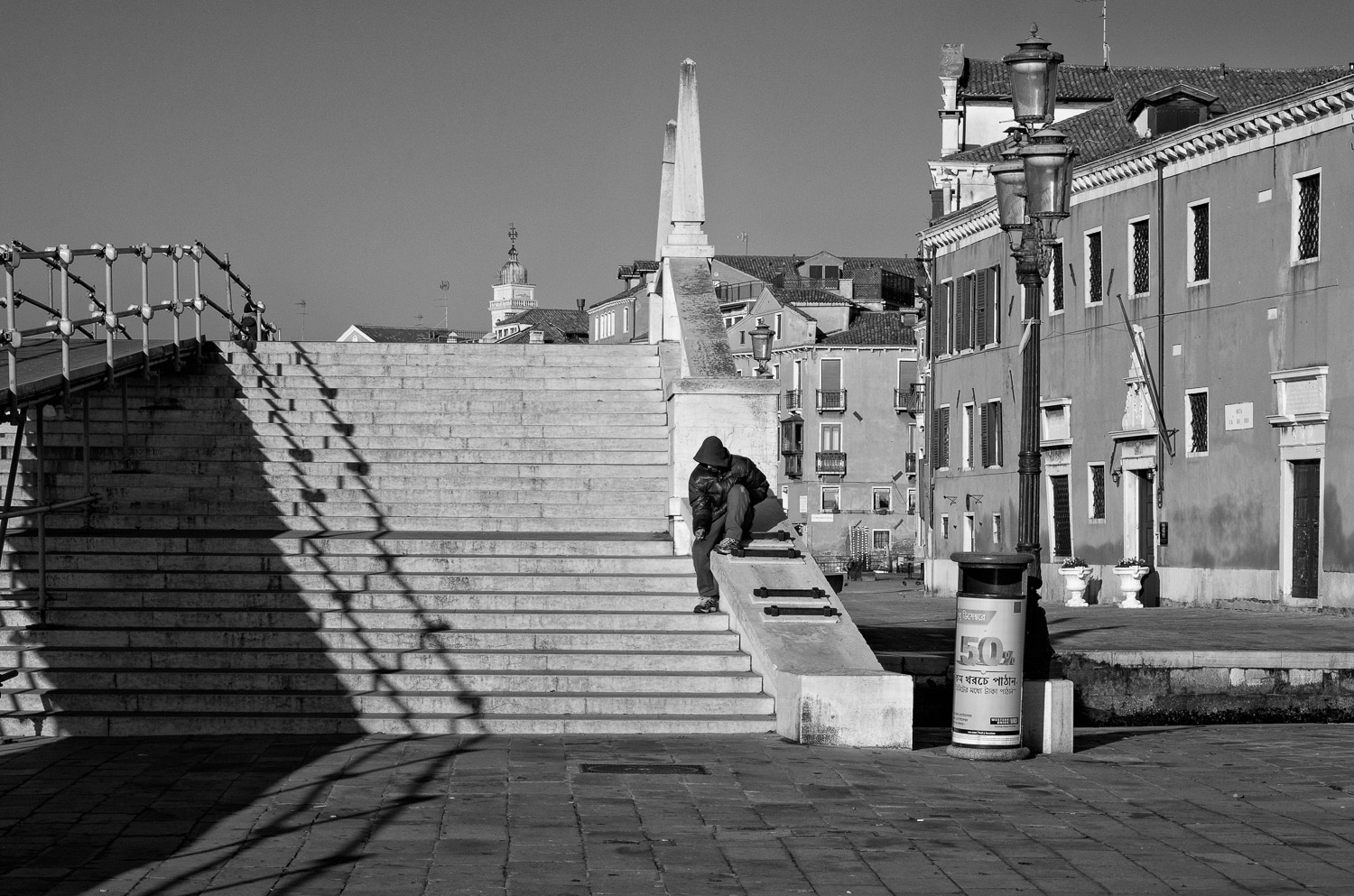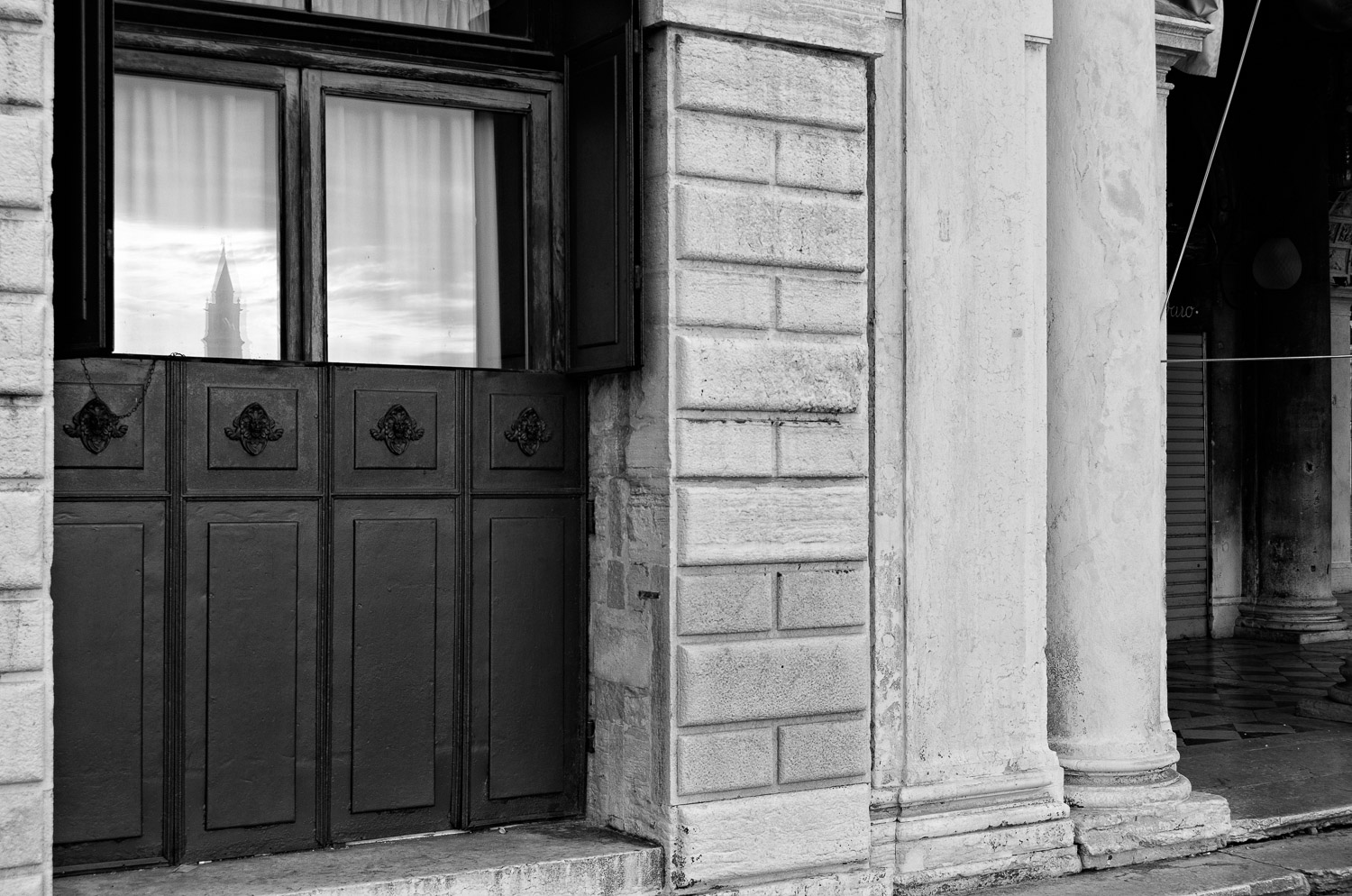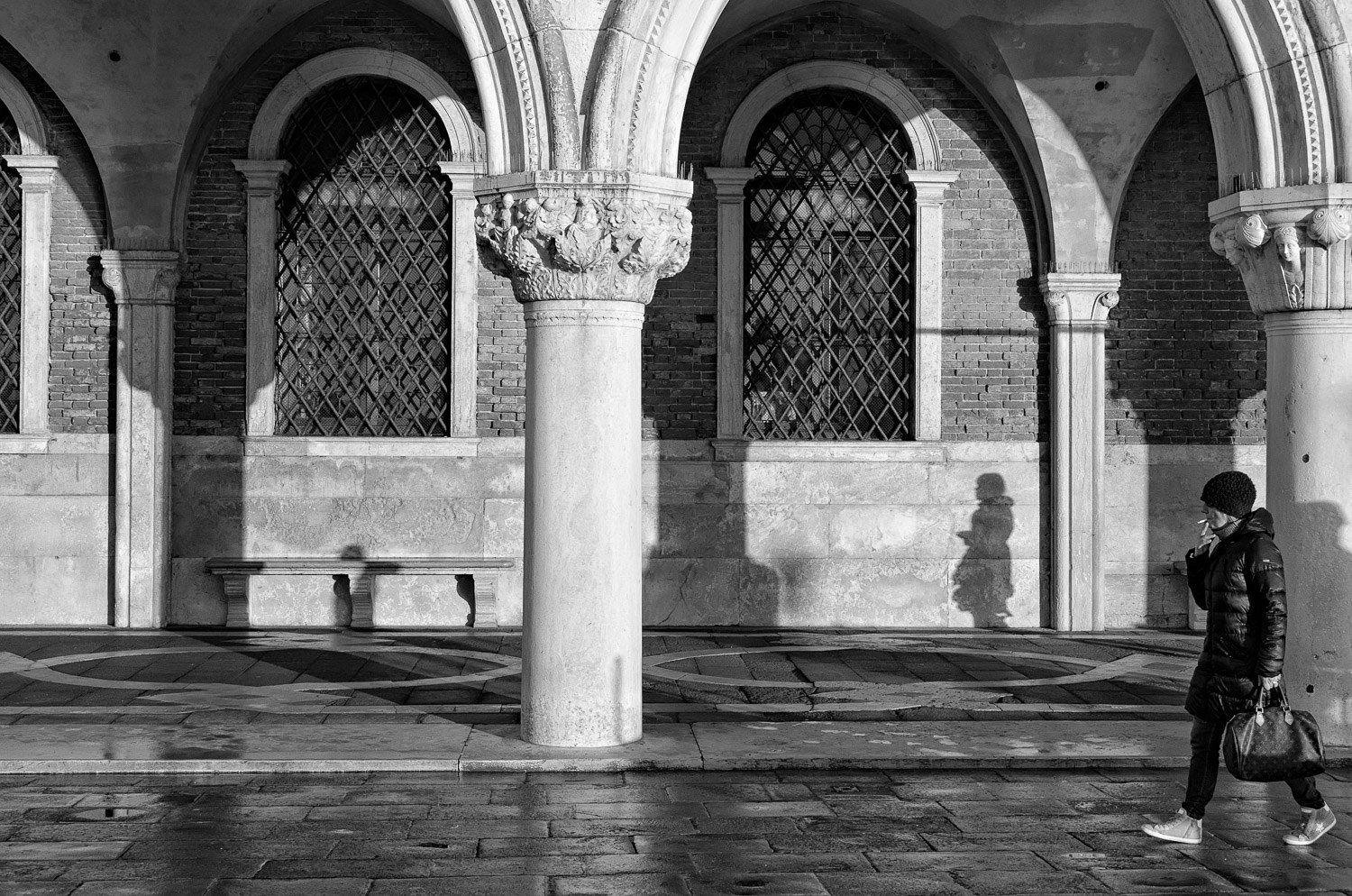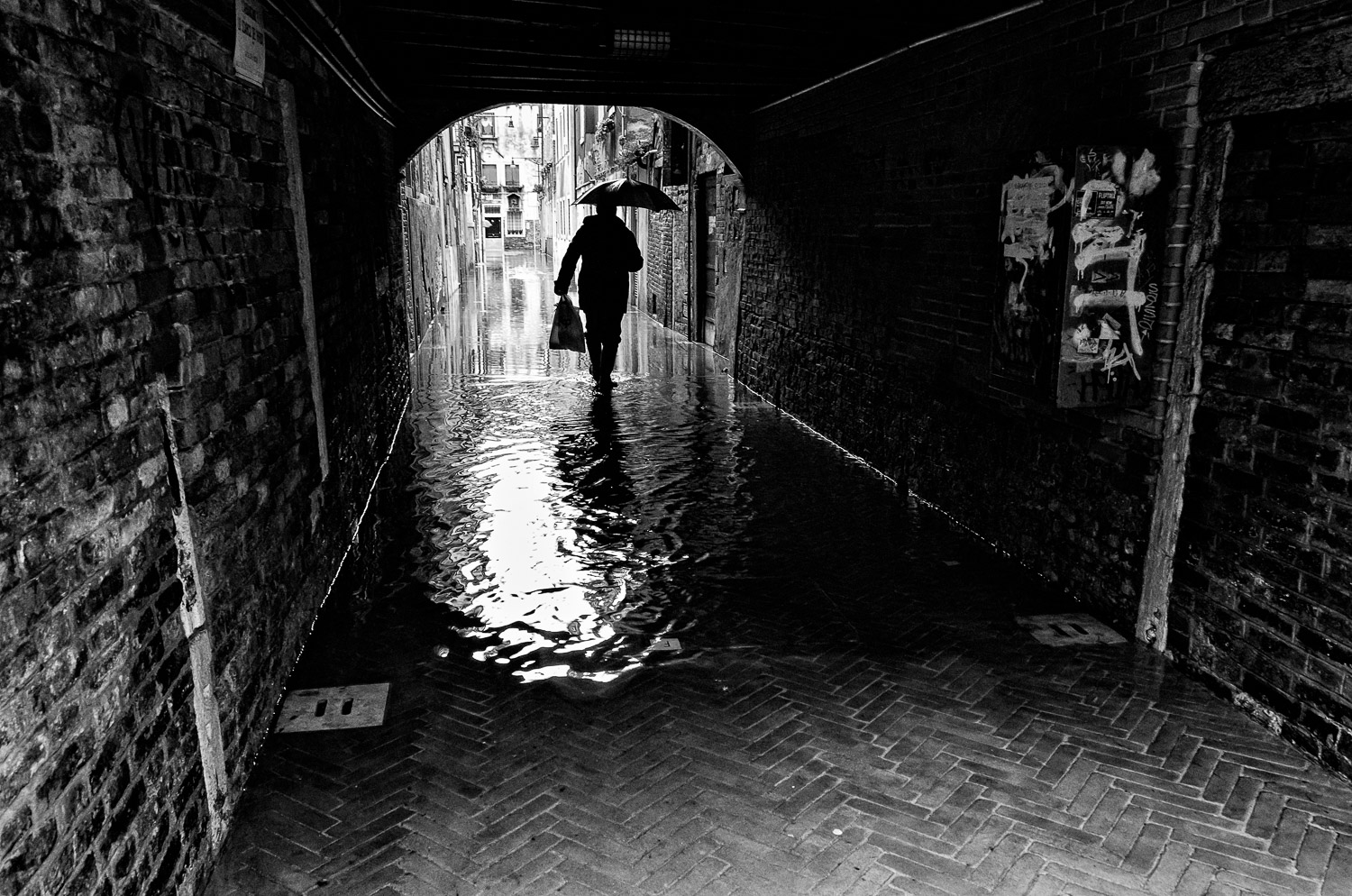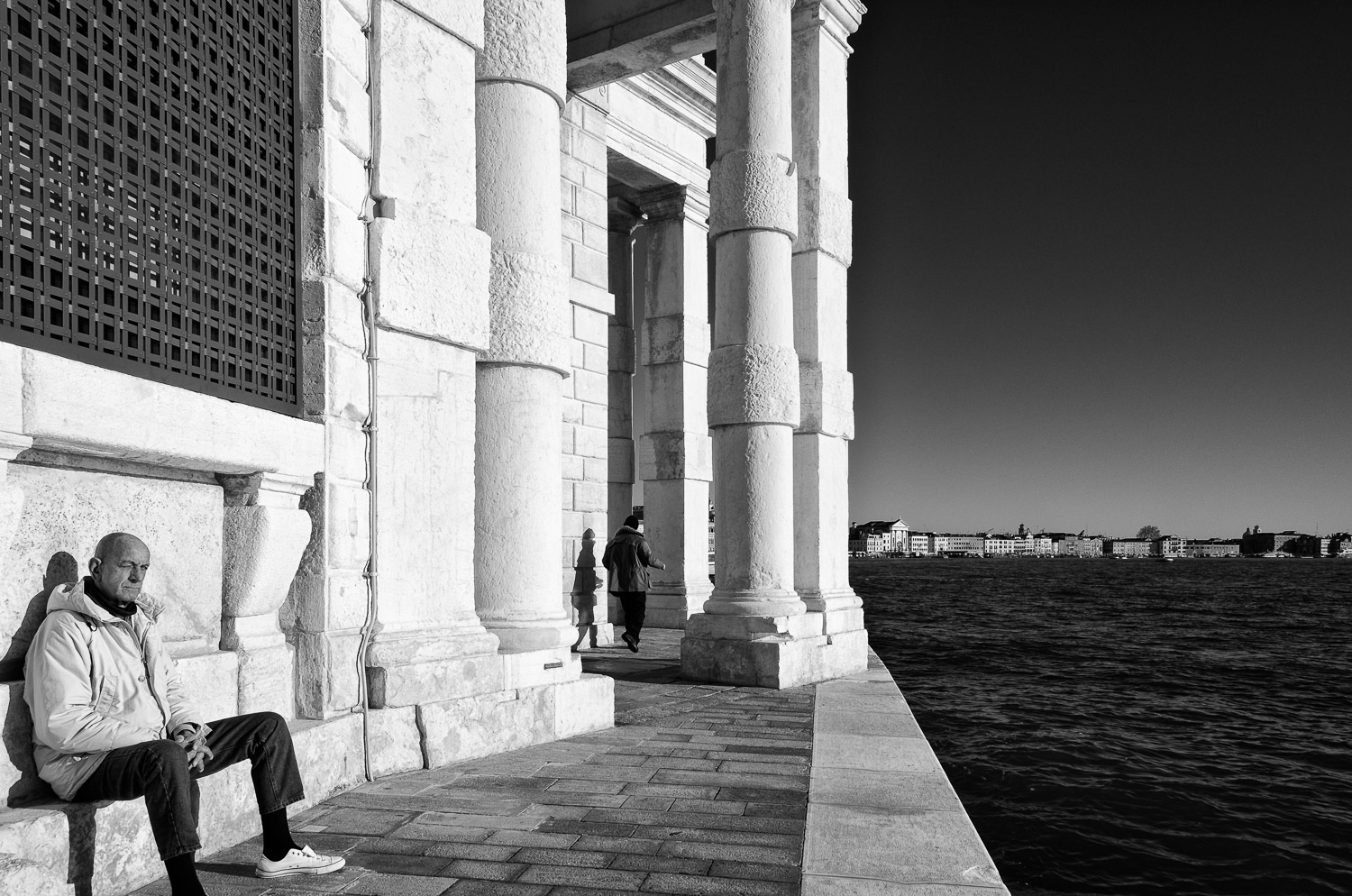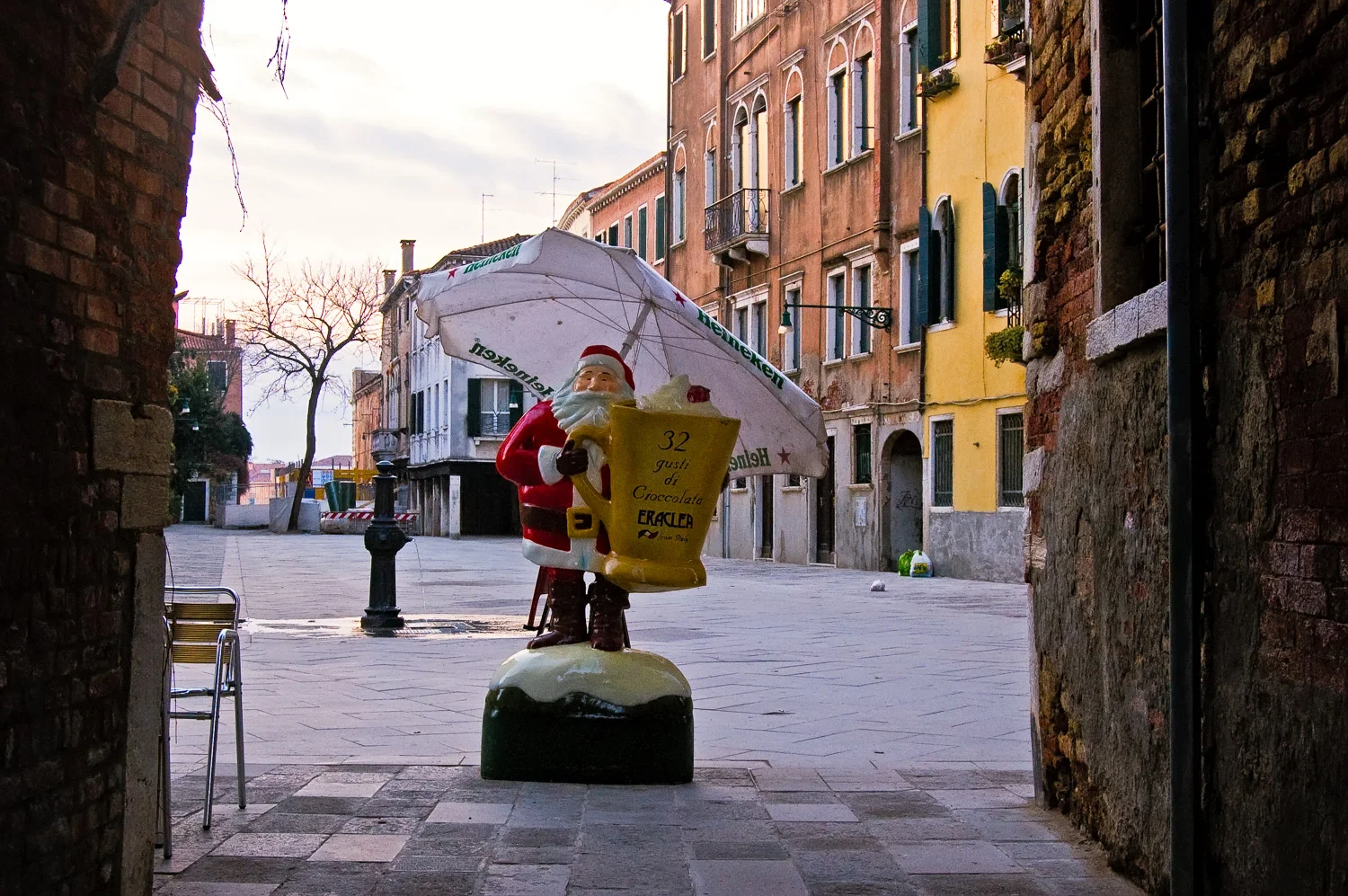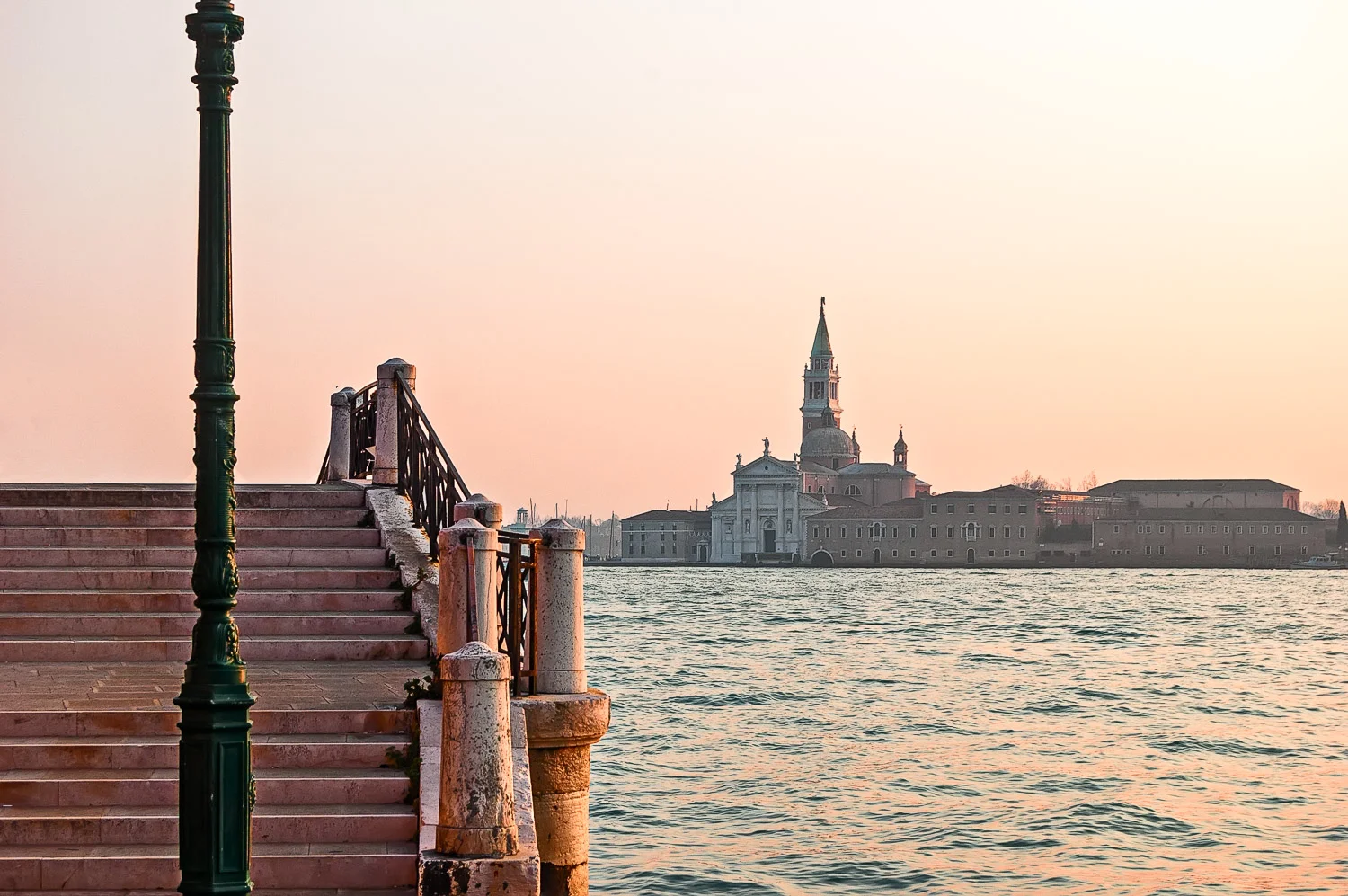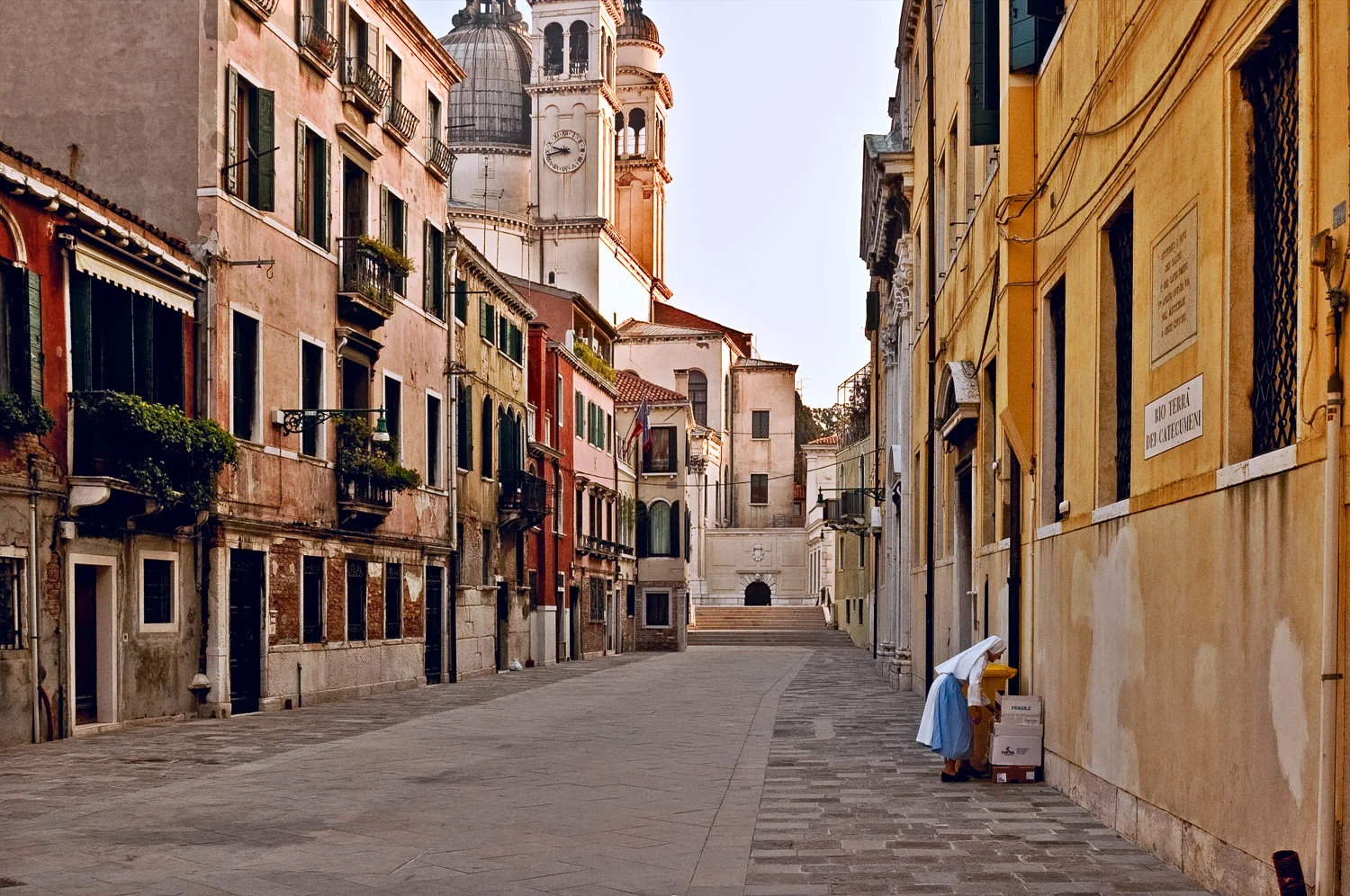
“This was Venice, the flattering and suspect beauty—this city, half fairy tale and half tourist trap, in whose insalubrious air the arts once rankly and voluptuously blossomed, where composers have been inspired to lulling tones of somniferous eroticism.”
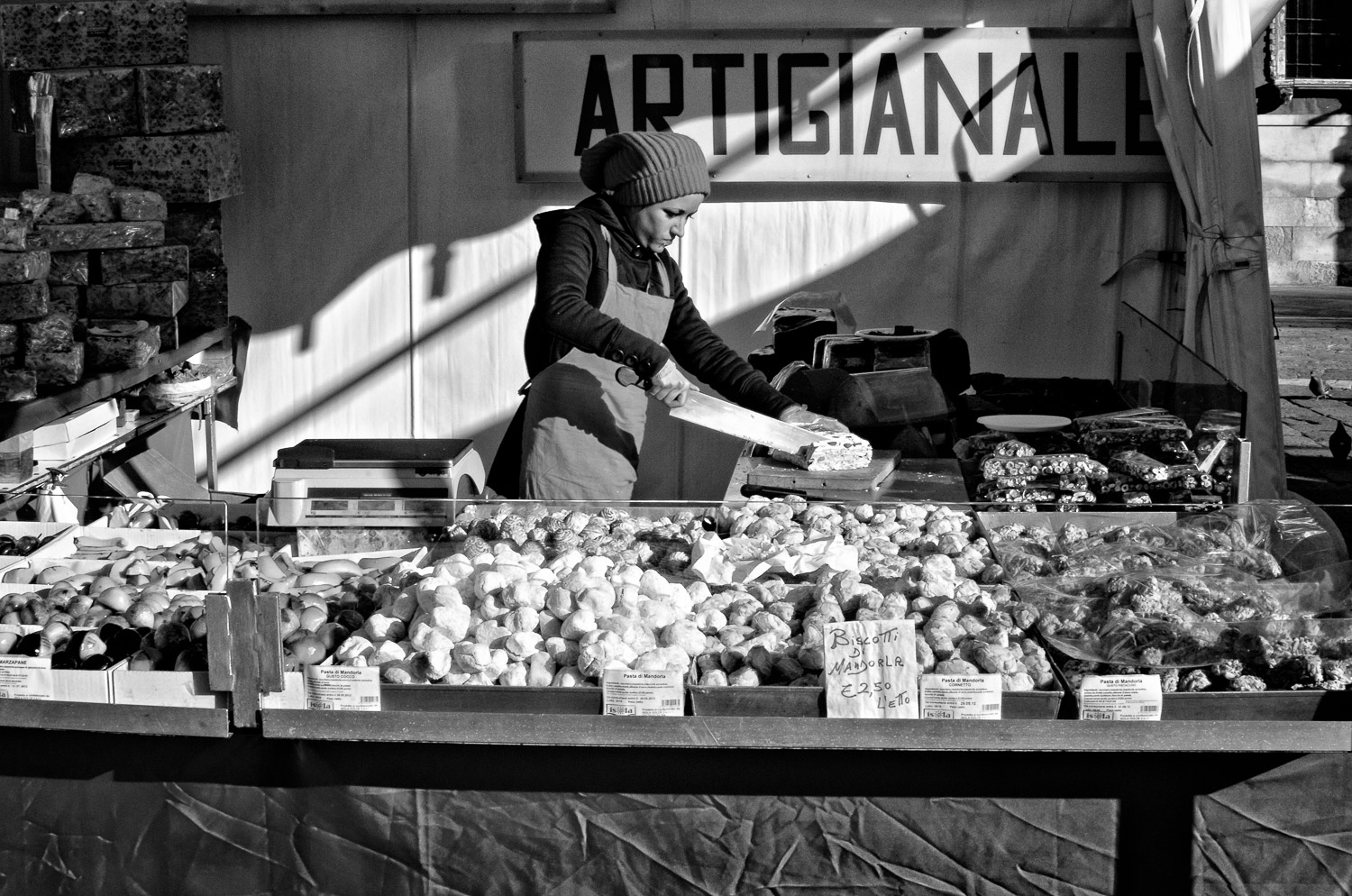
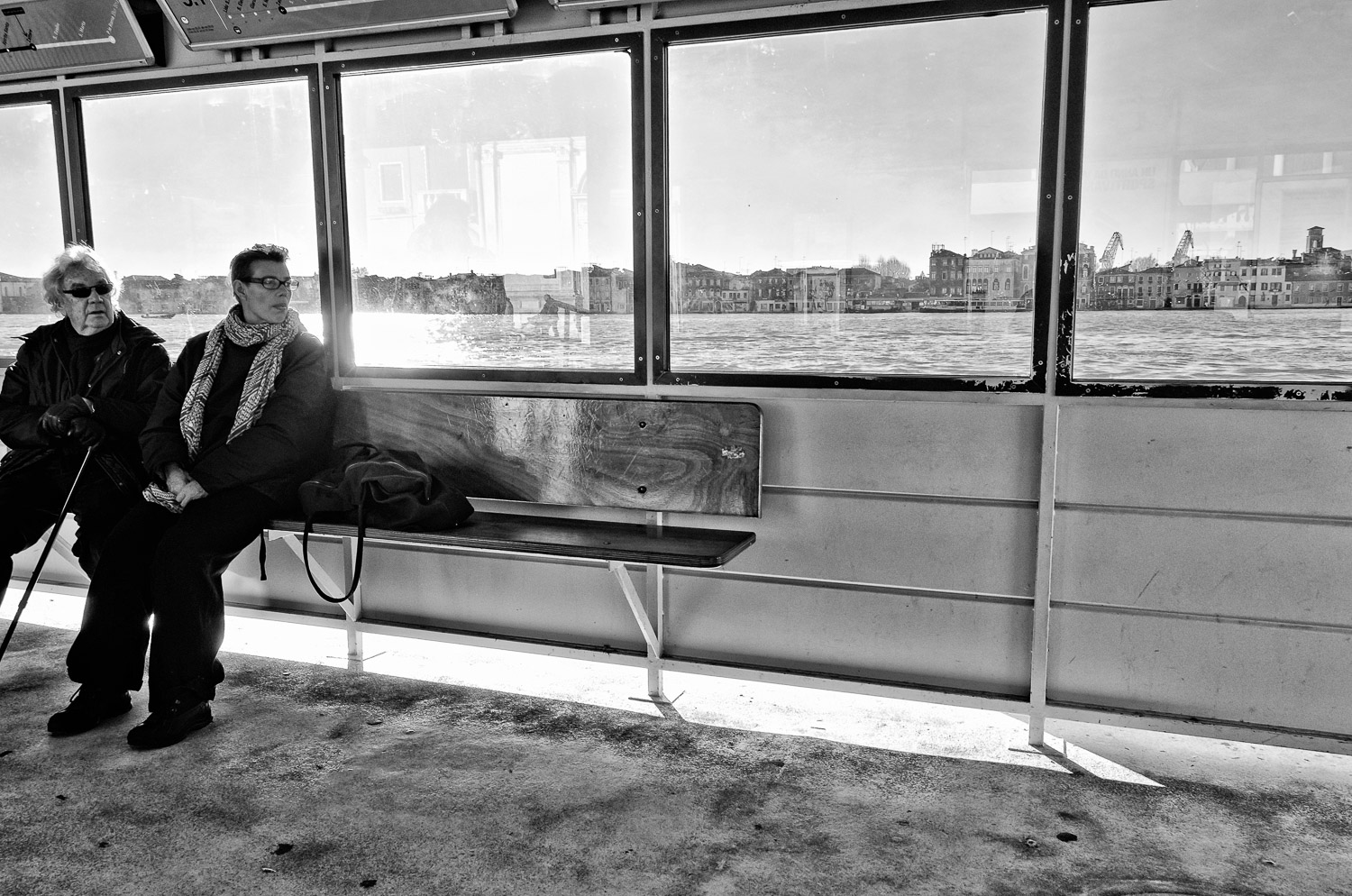
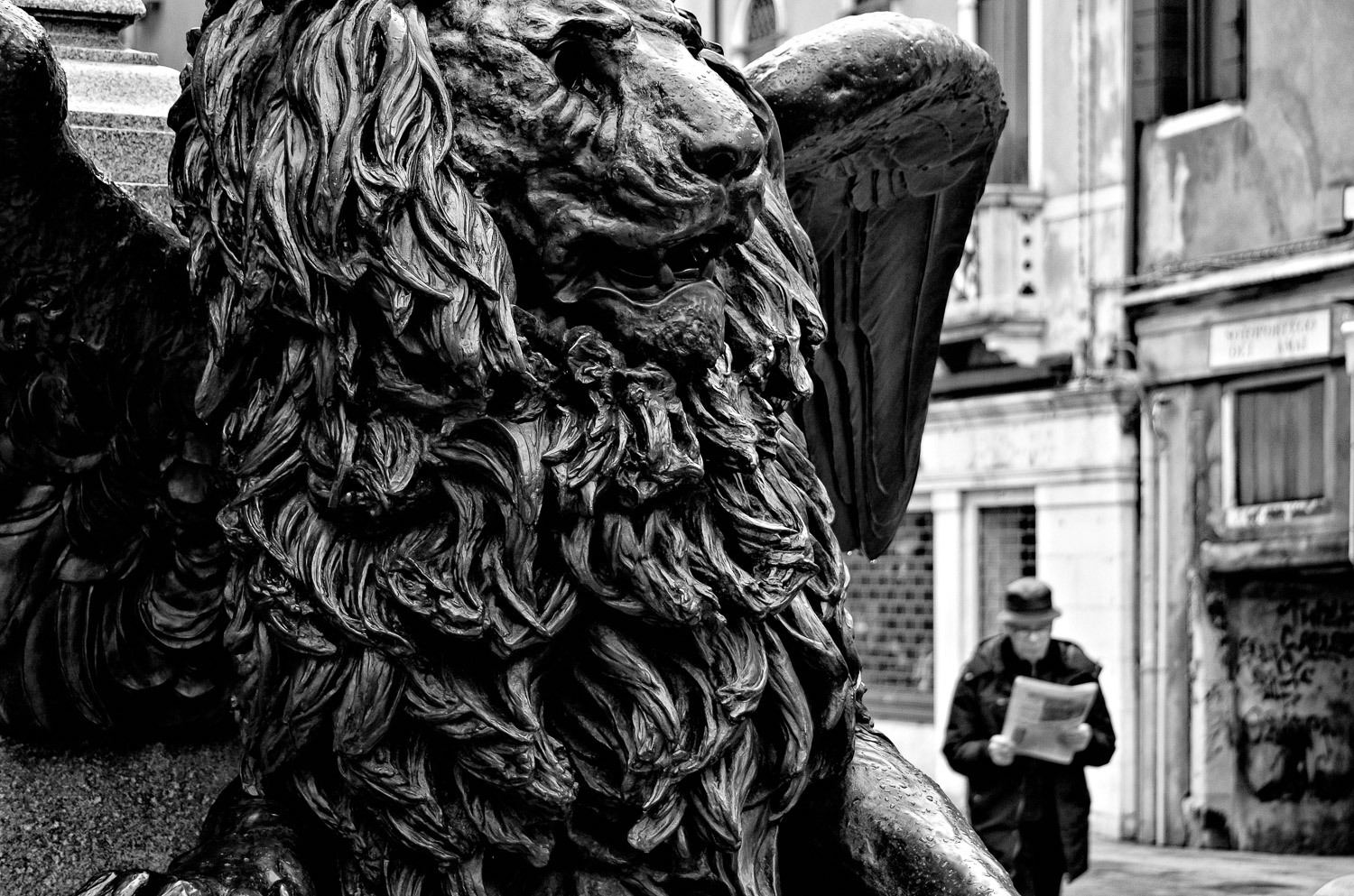
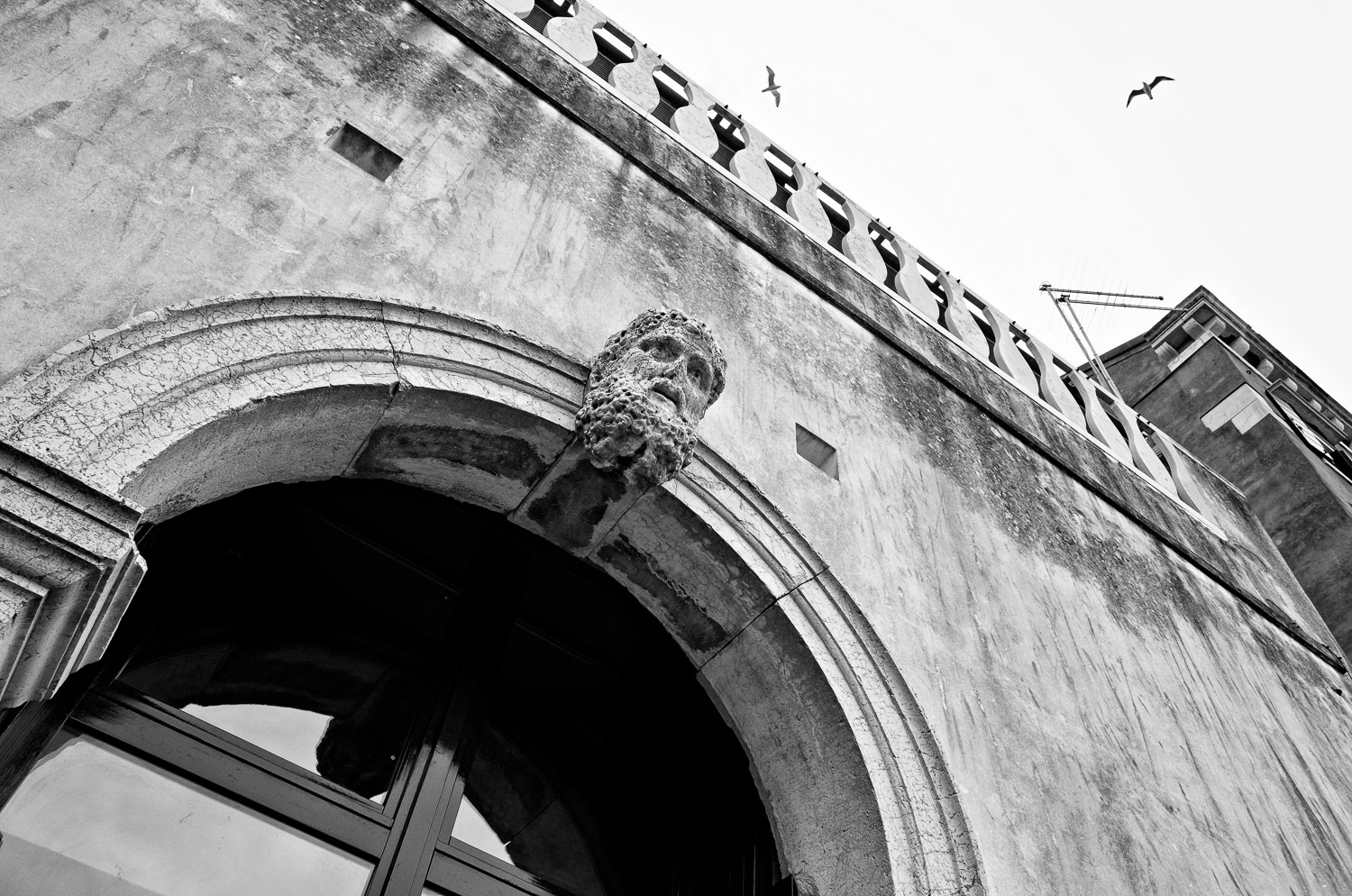
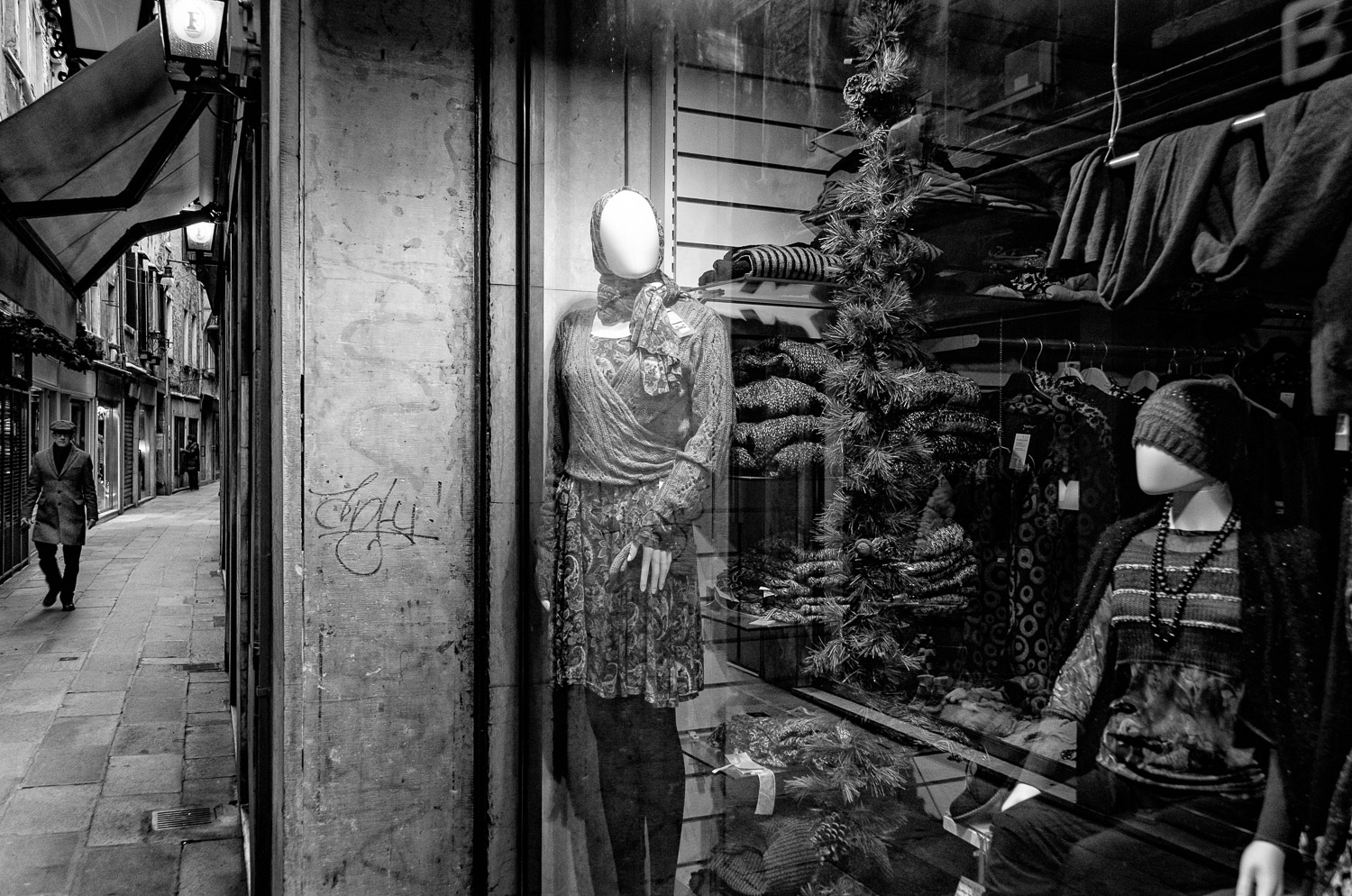
The colors of Venice are seductive and ever changing. Bright colors romp and dance in the reflections of Venetian waterways. Muted colors peek through the gauze of Venice’s fog. Graceful colors of centuries’ patina mix indescriminately with the gaudy spectrum of mass tourism and graffiti.
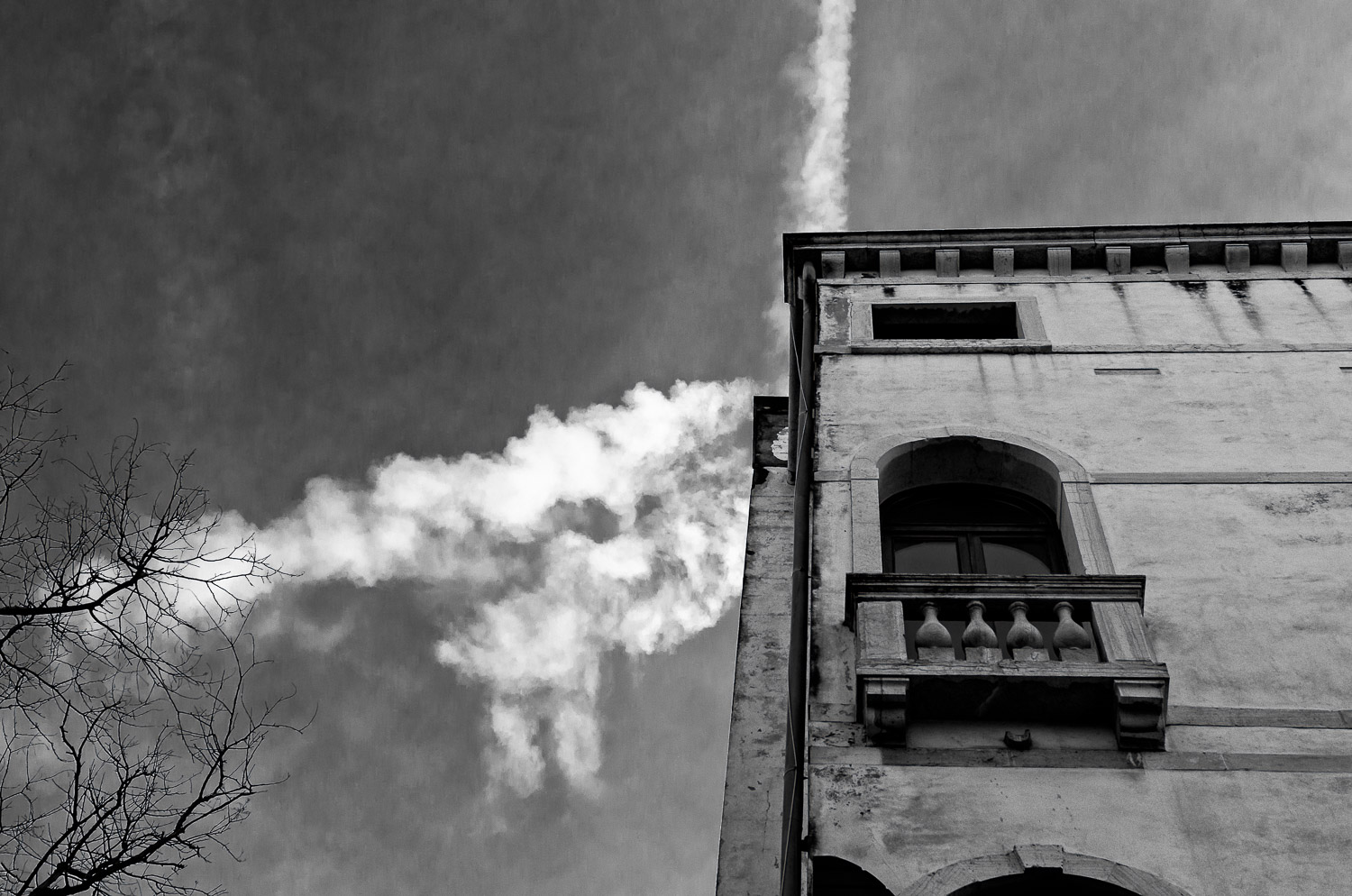
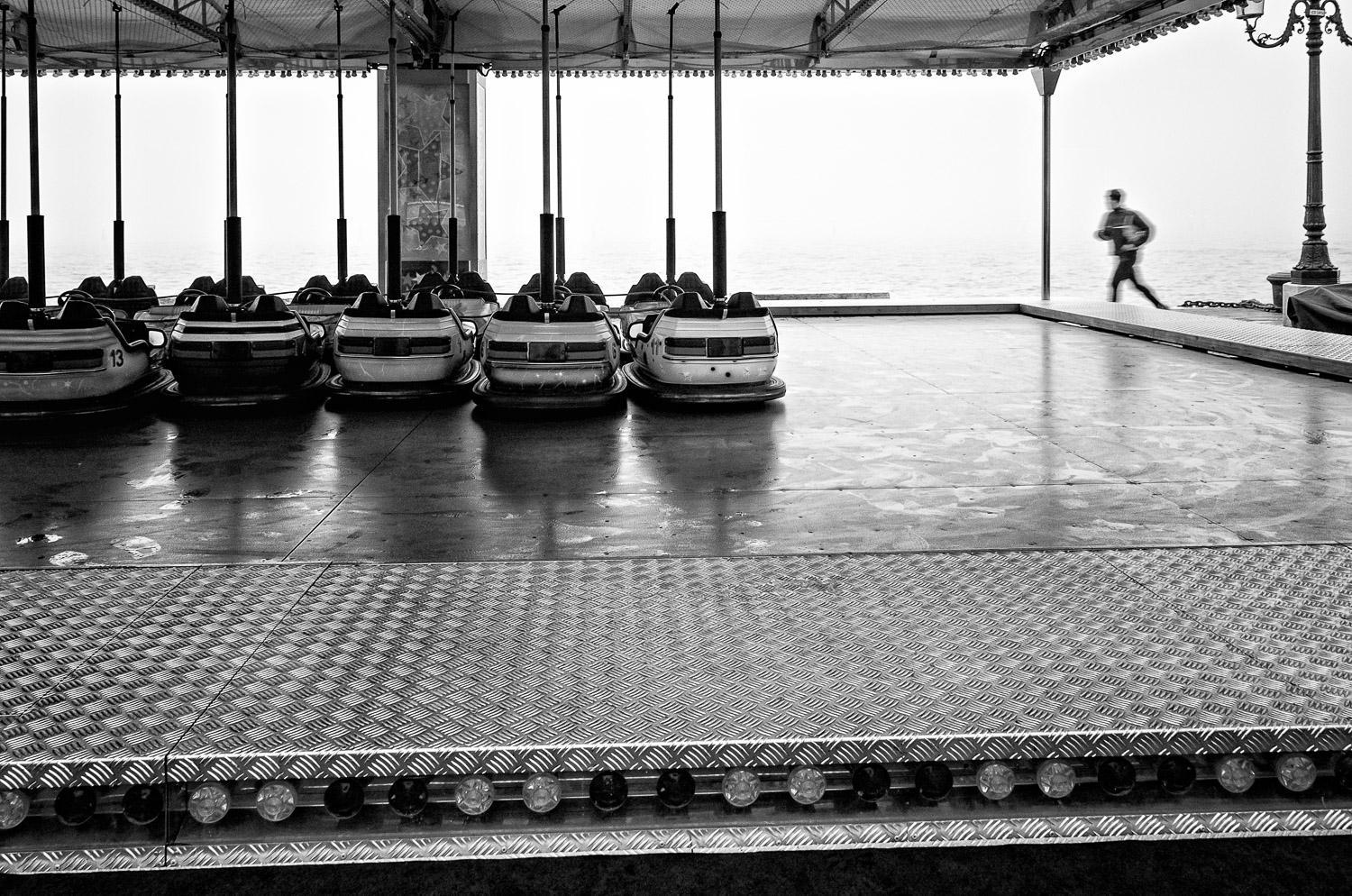
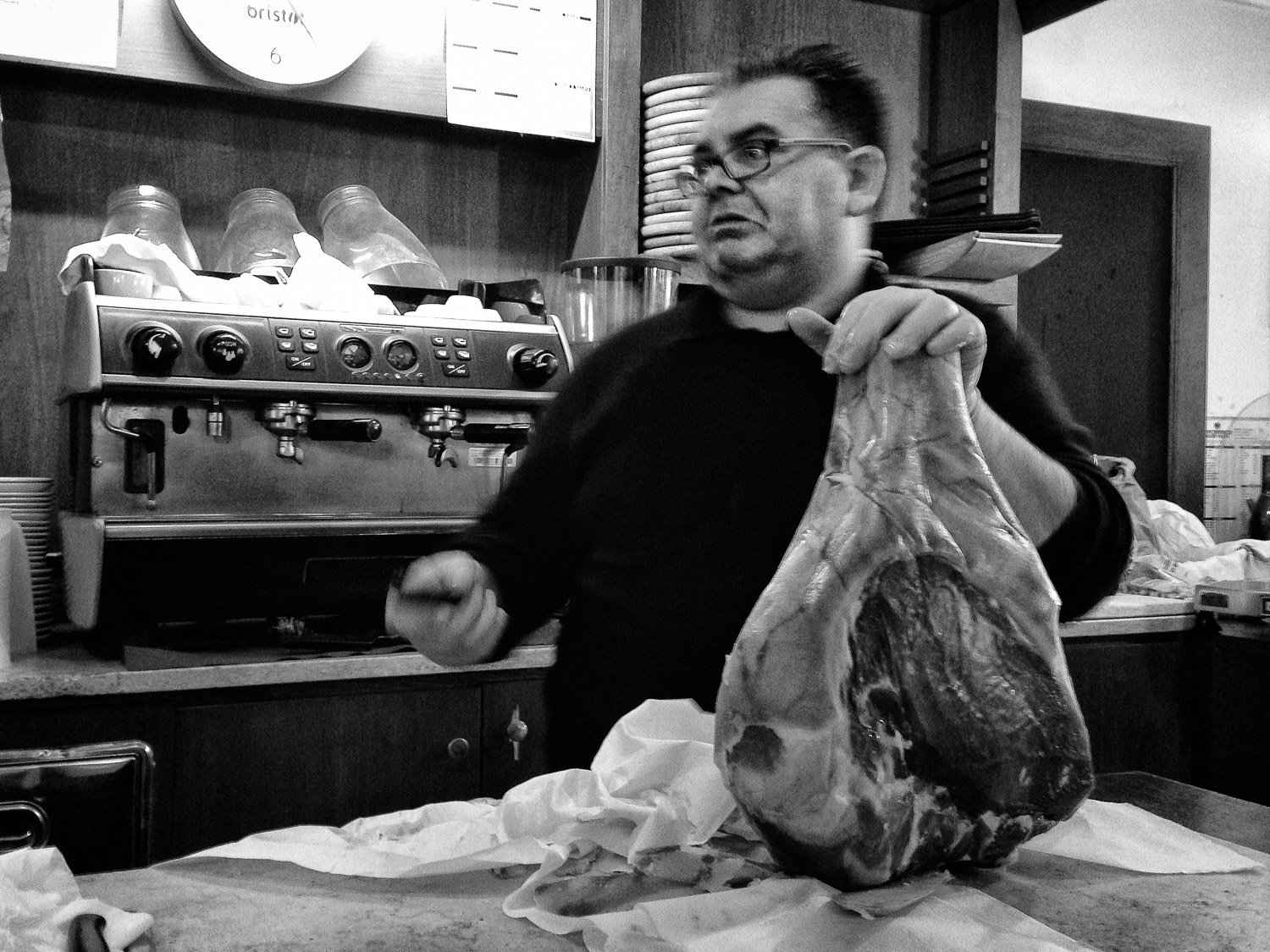
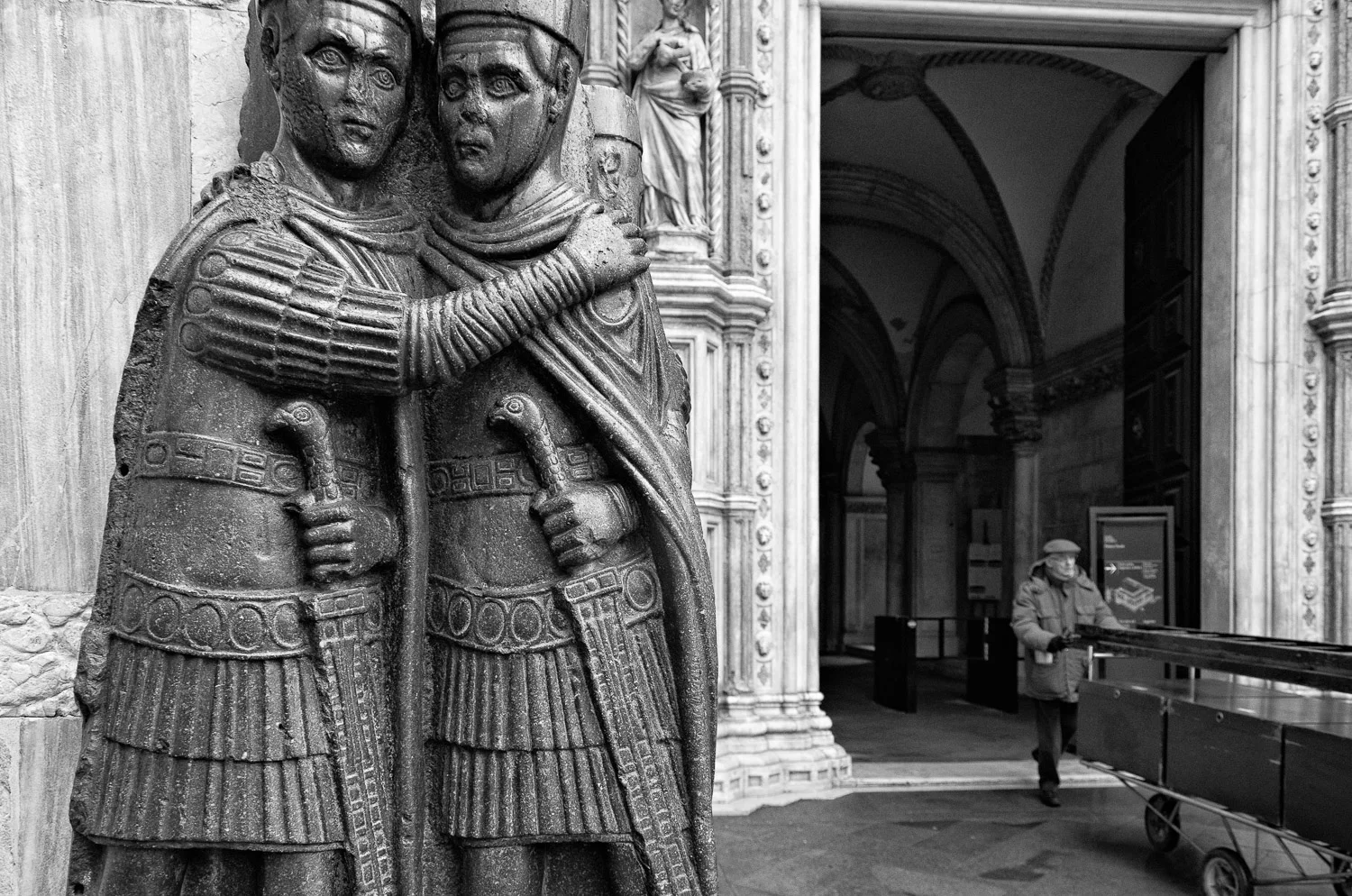
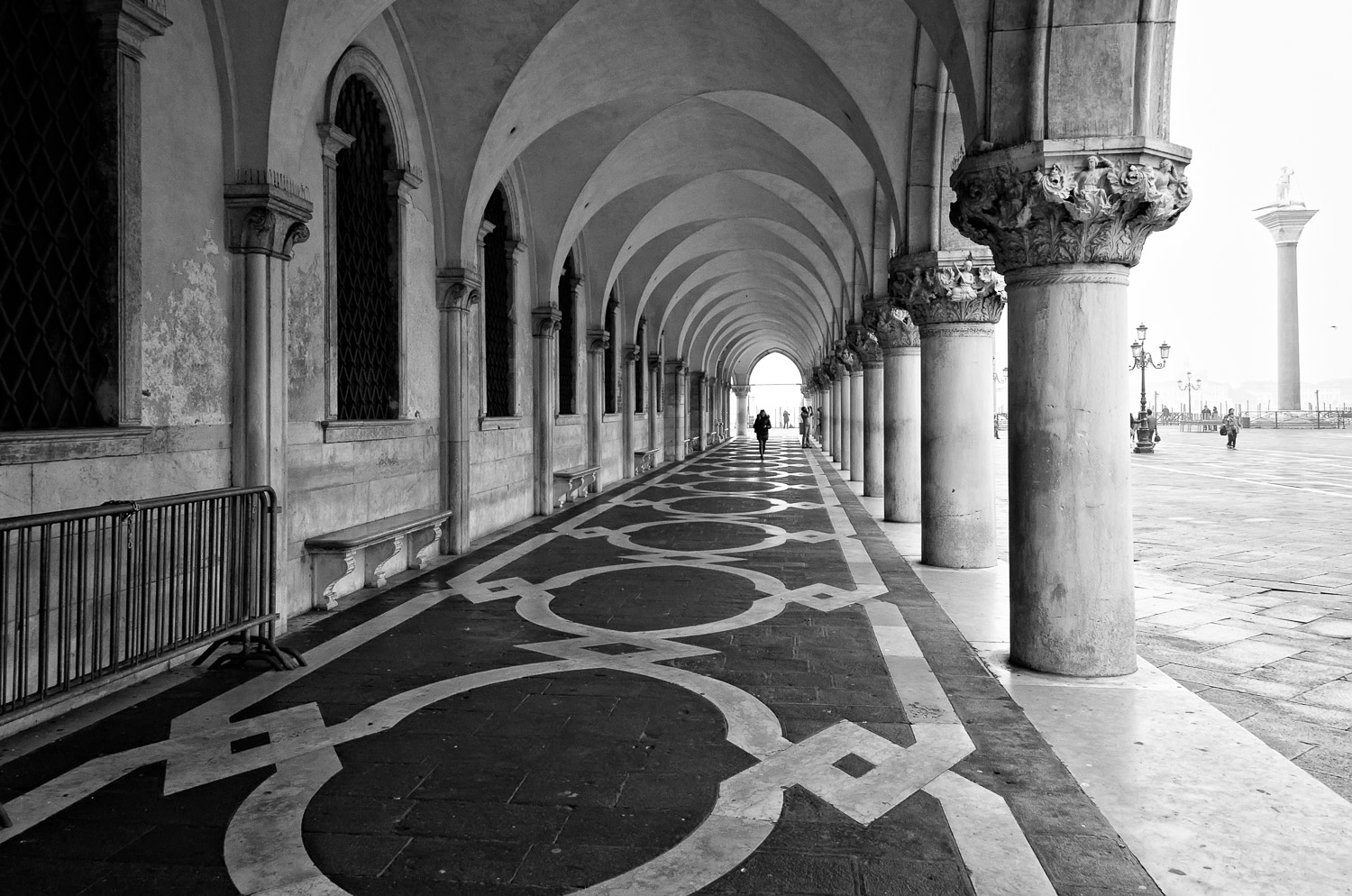
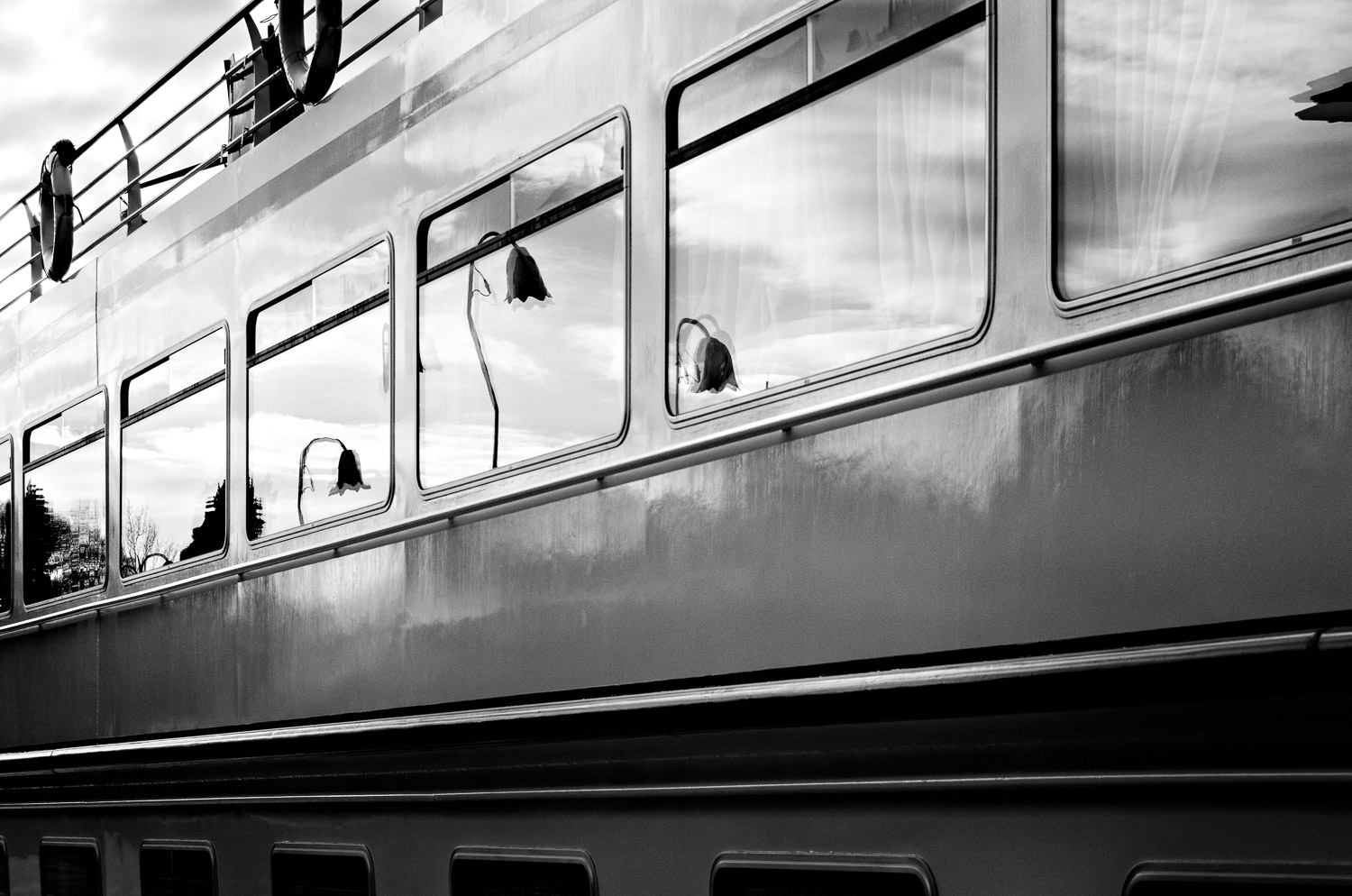
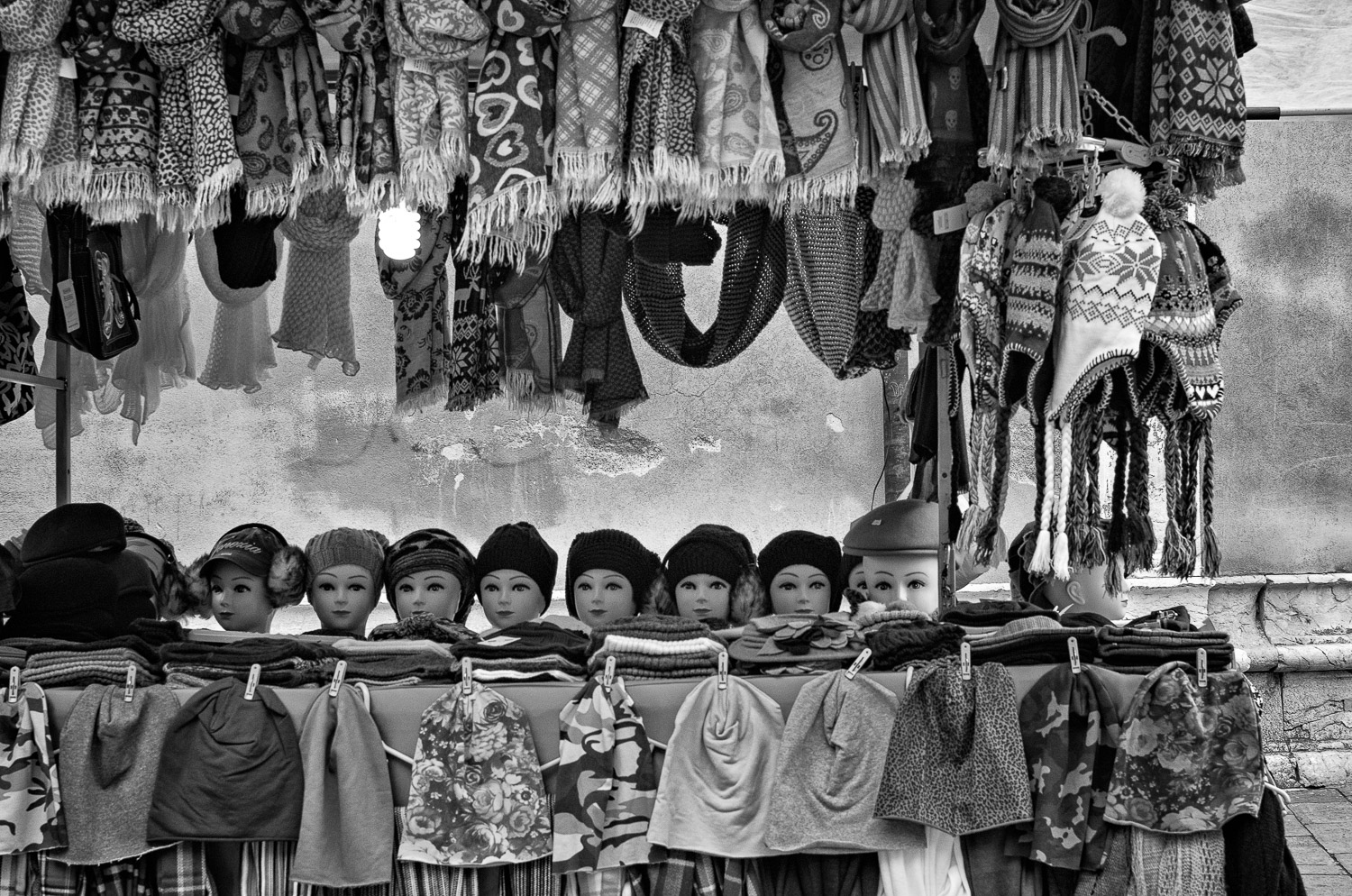
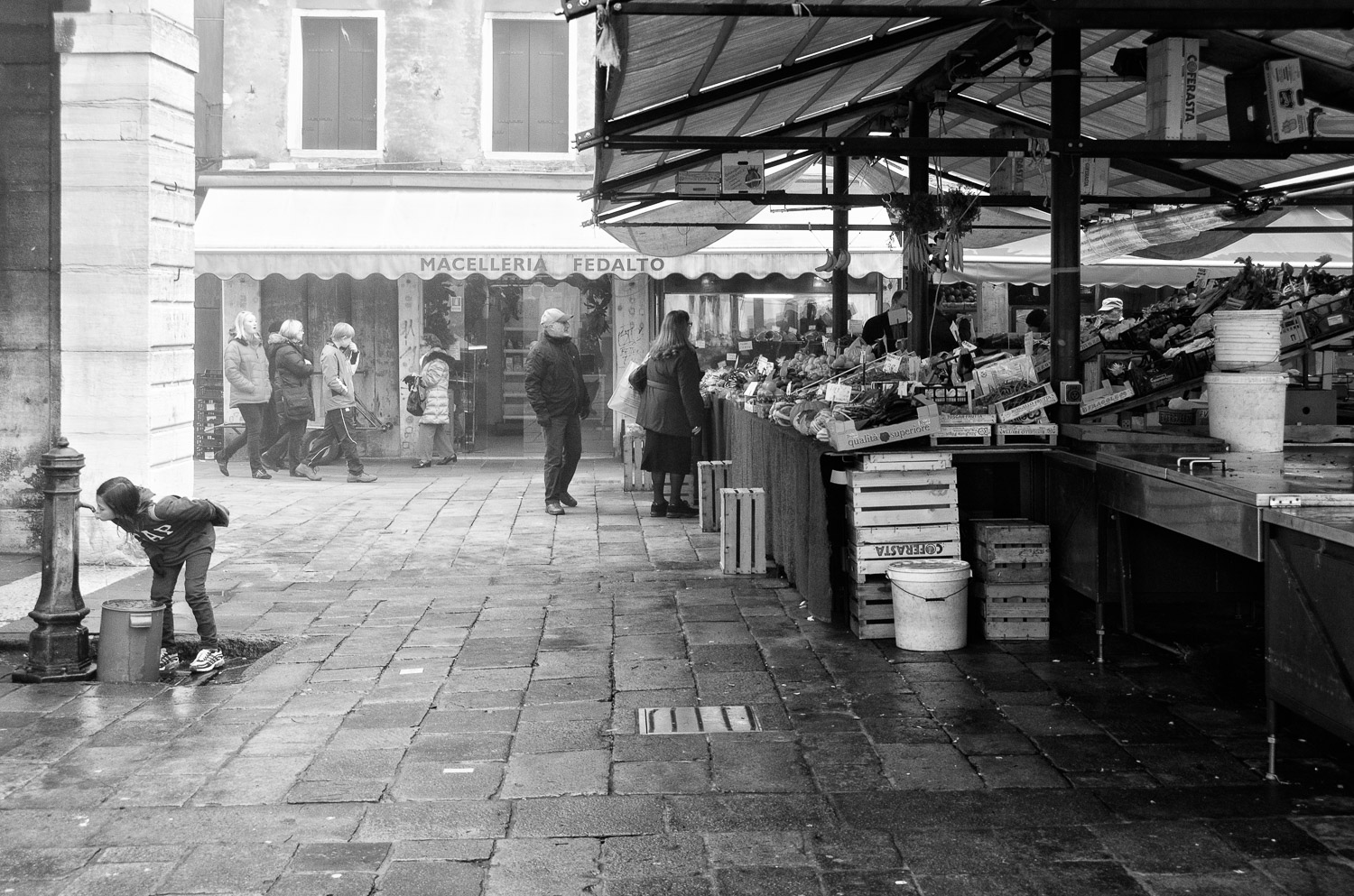
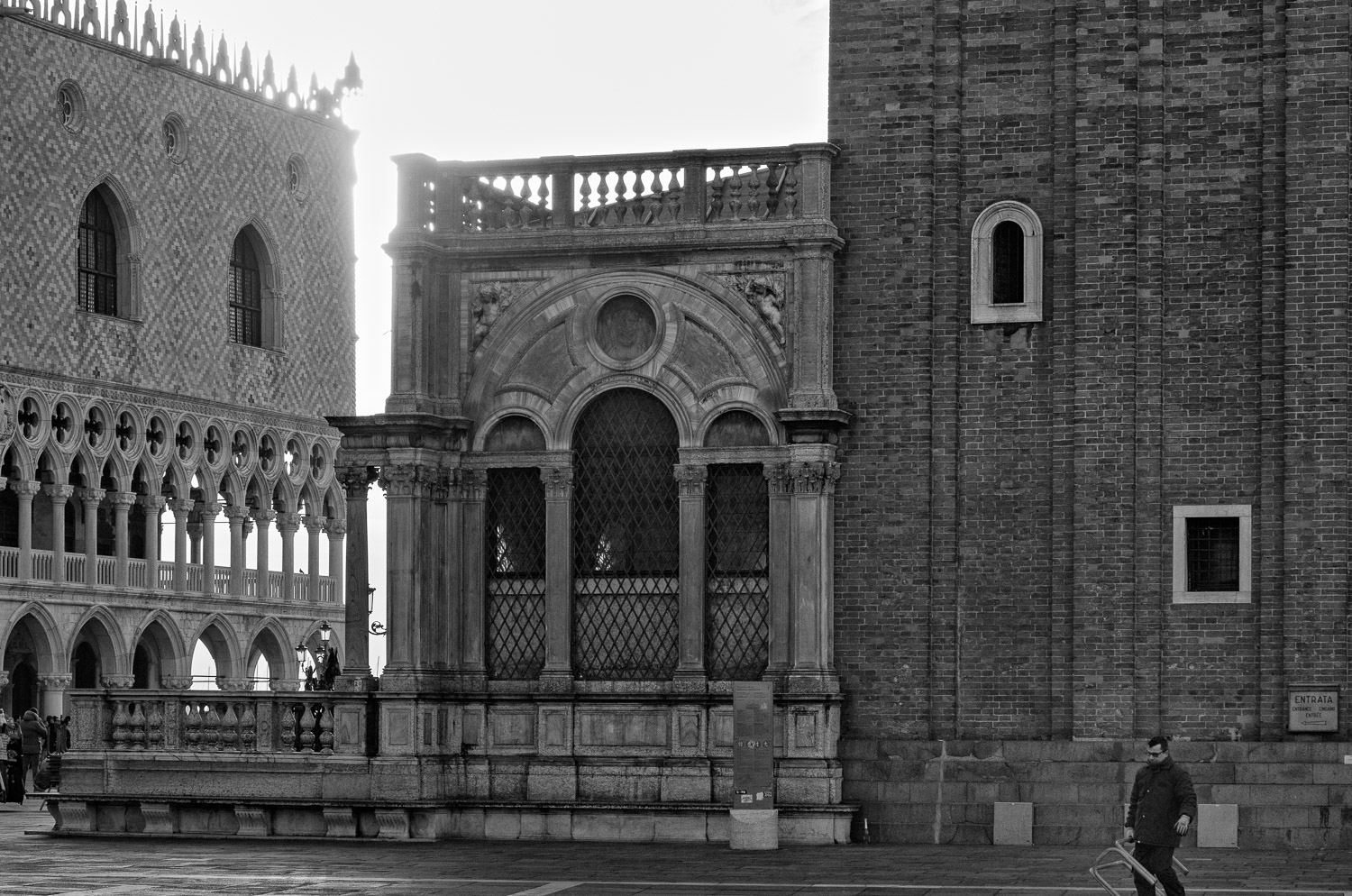
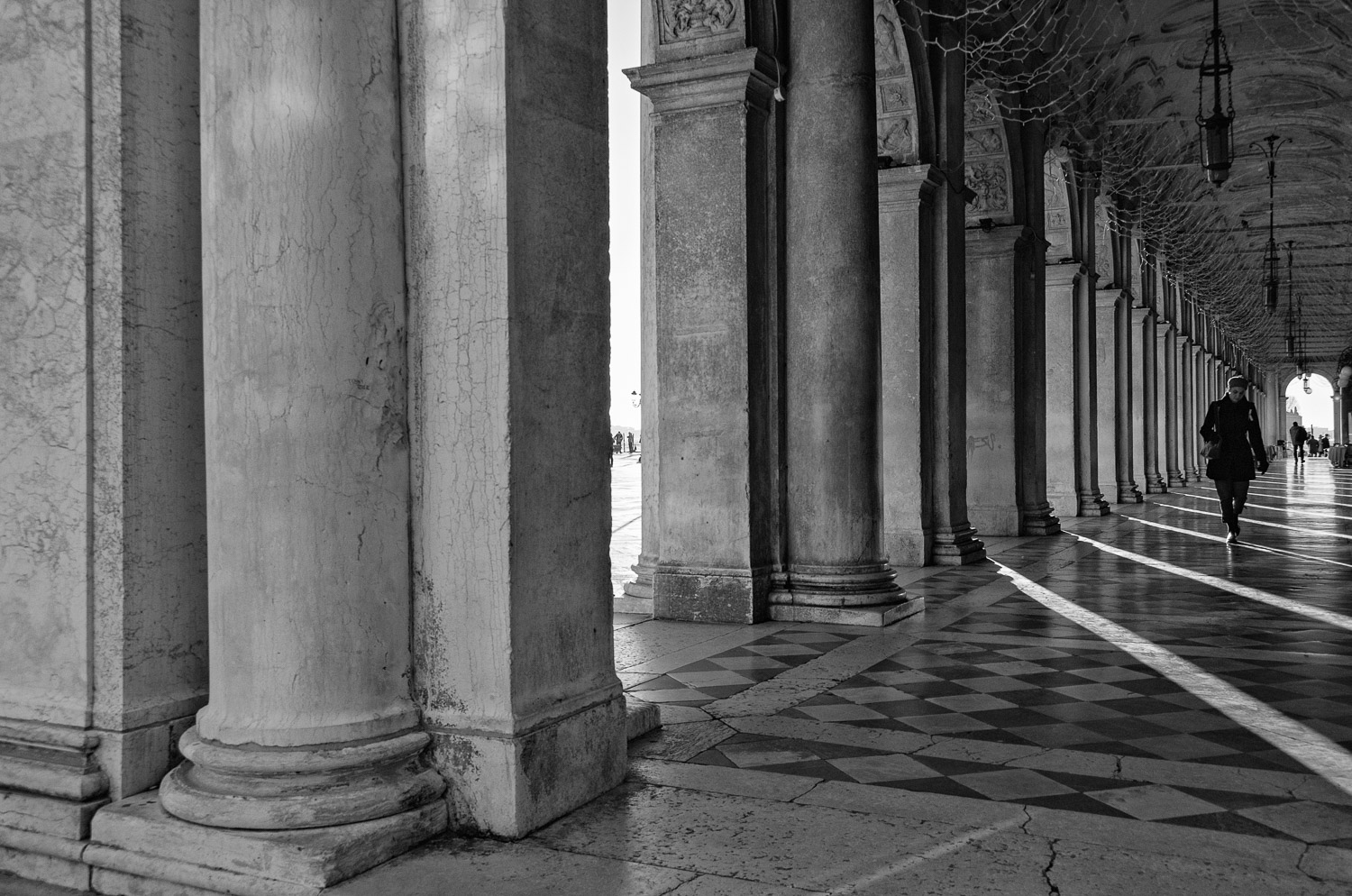
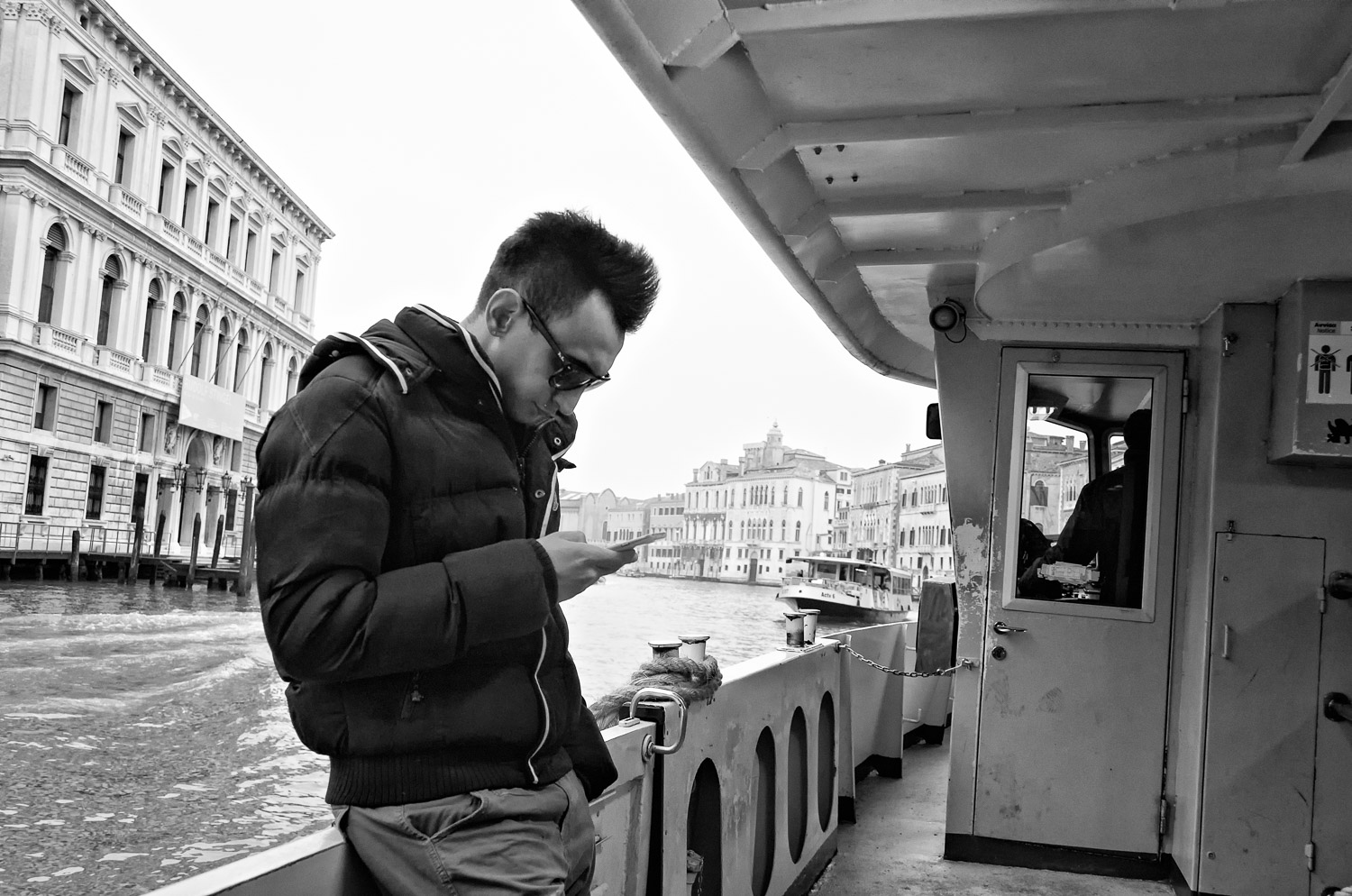
Black & white photography removes this vibrancy and transforms the cityscape by reduction. Venice feels older, denser, and more mysterious. Modern pedestrians becomes congruous with the ancient stones around them. Everything merges into a unique sensory experience that’s unique to this city.
Venice in black & white just feels right. The city has good bone structure and seems more handsome in monochrome. But, there is no right or wrong—Venice in color is a feast for the senses. For more of that, see our gallery, Venice in Color.
All the prints in this series are available for purchase. They will be featured soon on our online store. In the meantime, if you are interested in obtaining one, please contact us via email or via our contact form. All prints are printed with the finest pigment-based inks on archival museum-grade paper.
Related Writings
Morning walks on the boardwalks of the Jersey Shore—something I experienced often in my youth—were always weird. The amusements and food concessions were meant to be experienced at night, or at the very least at dusk. Mornings on the boardwalk were akin to waking up on the on the living room couch on the morning after a party. Stale odors and bits of refuse mixed with the ambience of the misty, salt air. The rising sun revealed stragglers who seemed just a little lost. The fun was over. Morning’s clarity brought new light to the hangover of too much fun and spent adrenaline. Yes, morning walks on the New Jersey’s boardwalks were strange—but I loved them anyway.
The fog of the Veneto had smothered the entire Venetian Lagoon with a cottony wall of cold vapor. There was nothing to see on this vaporetto ride out to the Lido—nothing outside the windows that is. Inside the cramped boat’s cabin, I stared at the back of a fellow passenger. He, in turn, was staring at the back of the person in front of him. And on it went from back to front of the boat. Like several hundred anchovies in a tin can—the salted kind from Sicily—we were jammed into the steel confines of this listing vessel. It seemed like a one-way trip to Purgatory.
The wind is howling this morning. It howled last night and for the three nights before that. Wind signals change. Something is blowing out and is being replaced by whatever is blowing in. By the time whatever is on the way actually arrives the wind will have wreaked its havoc. Broken planting pots, fallen garbage cans, branches and leaves are everywhere. This wind leaves behind the debris of change as it blows in something new. And I suspect that something new is the summer season.
The city, San Francisco or most any city, is full of small, fleeting treasures. Riches are everywhere—little vignettes of joy, intrigue, and ephemeral pleasure that compel me to click the shutter of my camera. Many are haphazard collections of life’s serendipity. Most affirm my belief that the cosmic powers that run this universe of ours have a very good sense of humor.
Three weeks in Venice is hardly a long time. But, at the start it felt that way. I fooled myself with the illusion was that I'd be there forever—that I was there for good. But, three days later I found myself counting. I was secretly counting the days until the arrival of my sad departure. I shook this diabolical countdown off with a shudder. But, it didn't work. The little clock continued ticking away in my brain and then chimed in again the very next morning.
It takes a week for the adrenaline to wear off. It takes longer than that for sting of jet lag to mellow. It takes time for one's ear warm to other languages. One's brain must sharpen to the constant calculation of currency exchange rates. But, once the body, mind, and soul convert to Italian it all changes. Life settles into the sweet cadence of life in Venice.
Venice is an enormous and endless treasure hunt. Obsessions are welcome here—whatever suits your fancy. I have friends who search the city for ancient graffiti, inscriptions, shrines to the Madonna, mysterious symbols and even ancient splash guards that discourage public urination. I was inspired by these efforts. So, on one day in early January, while looking up at the Lion of St. Mark, in Piazzetta San Marco, I decided to collect lions.
"It's their last day tomorrow! Christmas Eve will be it for them."
I could hardly believe my ears. Our friend was pointing at the vegetable barge of Campo San Barnaba. The boat had had the best produce in the city and was a landmark of old Venice. The two brothers who ran the barge for many years were, alas, retiring. No other Venetians wanted to buy the business and their children had no interest in selling vegetables from a canal. So, this would be it. One more day and another piece of Venice would crumble away with time.
Venice is a place of shifting perspective. Nothing is fixed about the place, nothing is permanent. It changes and transforms with the crossing of every bridge and the winding of every alley. Crystalline sunshine turns to pearly fog in a moment. Shadows sneak along, tides flow in and then out. Low water becomes high and then low and then high again. Deserted streets jam up with crowds then become deserted once again. Tensions build and then relax. Pay attention in Venice! Things will surely change within moments.
A return to Venice is like the reoccurrence of a familiar dream. This should be no surprise as Venice is often more dreamlike than real. If it were not for its sturdy stones we would barely be able to grasp and hold on to much of Venice at all. Perhaps the real Venice lies in its shimmering and amorphous reflections. Looking down into the lagoon and its tributary canals often reveals a truer Venice than the one carved out of Istrian limestone. So the true return to Venice must be by water where one can behold both city against the sky and its wavy and moving mirror image that lies within the sea. That way both dream and reality mingle in the misty light of La Serenissima.
Today will be the day. I lifted my heavy legs off the bed and swung them around to the wooden floor. Making certain that they were firmly rooted I rose carefully, only to be greeted by a wave-like sensation. Was the floor swaying or was it just me? I quickly realized the obvious. Jet lag! No, today would not be the day. Nor would it be the next day. There would be no blogging. None. It would have to wait until the dense fog of travel had lifted. I would need to be patient.
Usually, the newspaper has a perfunctory little story on the longest day of the year. It usually starts out with, "Today is the longest day of the year," or other such witty prose. Newspapers have a habit of repeating things incessantly like little children who have just learned a new word. Another repeated annoyance is the proclamation at the start of California's fire season. "This year is predicted to be the worst fire season on record." Every year is predicted to be the worst fire season on record.
I am a shy photographer. Rarely do I feel comfortable carrying my camera in a crowd. I take great pains to be invisible and to make myself less obvious. But—once I get lost in the process, once the light is right and I find something that captivates me—I forget to be self-conscious. I forget my story. I get lost.
They tell me that the past and the future are mere illusions—this is what I am told by the great teachers of wisdom and spirit. I am told that the only thing that we really have is the present moment. The here and now. Yet, the ghosts continue to visit me at the most inopportune times. They are the swirling winds of my past, the floating ghosts of this life that I know.
It could not be so. Fifteen days in Venice seemed like a long time during the planning stages of this adventure. Fifteen days as a visitor in any city should be enough. There have been places—the memories are sadly indelible—that have worn on my psyche after a single night. Fifteen days in Venice in the dead of winter, it should have been enough. It wasn't.
We have met many times, he and I. In a tiny park, to adjacent to Basilica di Santa Maria della Salute, stands a statue of a bearded man. He is frozen in a terrified state, looking upwards to heaven. His arms are missing. His features are slowing being worn away by time, rain, and the gunk spewed out by industry and cruise ships. Every time I return to Venice I visit him—and wonder about him.
I rose early, as always, for my dawn walk in Venice. This was my time alone with the city, a time when I could inhale deeply the salty air, and search out the meager bits of golden light that might be found shimmering here-and-there, from time-to-time. Finding Venetian sun in late December would not be easy. The light was low and the alleys tall. I wound my way out into the open piazza at the front of the Santa Maria della Salute. The massive edifice cast its shadow upon me with the pull of its gravity. I looked up to the screaming angels—a baroque cacophony of heavy Catholicism. I wondered to myself how long it had been since my last confession.
On a balmy, spring evening in May of 1991, we discovered Piazza San Marco for the first time. The bands were playing on both sides of the piazza. Waiters glided from table to table. The passing crowd swirled and flowed en masse, like the foam of a gigantic tide pool. The briny air, given life by the day's heat, was now aloft with a gentle breeze. The piazza seemed lit from within with the spontaneity and glow of an impressionistic painting. This first night has been forever frozen in my mind, and it shall never change. This is how I will forever remember Piazza San Marco.
Venice, Day 4. The office wasn't where it was supposed to be. And then when it was where it was, it was closed. This is the Italian bureaucracy. To ordered, logical minds it's infuriating. Yet, with some practice, dealing with the Italian *statali*, or government workers, can result in a pleasant, and altered, state of consciousness. Simply abandon your plans and any expectations. And find a bar.
It has been said many times that Venice is being loved to death. I wonder if photographing it hastens its demise? Do we become so jaded by the myriad images of Venice that they begin to bore us? How many photos of the campanile of Piazza San Marco can we look at before stifling a yawn? What do a million Internet photos of Venice do to our perception of this great place? How about a billion photos?
The vaporetto is Venice's public transit service. Venice being Venice, the public transit does not have tires nor rides on rails. It floats. This alone makes it superior to any public bus, train, or subway on earth. Add in the canals and lagoons of Venice and the comparison to public transit anywhere else becomes a bit silly. Riding a vaporetto is like nothing else that life has to offer.
It's a absurd notion. Thousands of tourists jam into Venice on a daily basis. Save a few weeks between the Befana and Carnivale, there is no off-season anymore for a city that called itself The Most Serene. Being alone in Venice truly is an absurd notion. Or maybe it's simply a state of mind.
The *motoscafo* is the Venetian version of a taxi. Since Venetian avenues are of water, its taxis are, of course, not automobiles. They are boats. However, to simply label a motoscafo as a boat is a gross disservice. To be the passenger of a motoscafo is like being a time traveler, an exotic adventurer, the hero of a romantic novel, or maybe even a movie star. Add your own imagination, your own superlative. One transforms immediately upon stepping down into the rocking craft. The ride in a Venetian taxi is one of the few things in life that surpasses the expectation. It's that good…that exciting.
Venice is a city of changing moods. Of changing cycles. It is a city that never seems at peace for very long, the victim of its stunning location and aching beauty. There always seems to be comings and goings to give Venetians something of concern.
It is our first morning in Venice and it is raining. I am undaunted. Great cities like Venice transcend weather and climate. My only complaint is that I must hold both camera and umbrella with the same hand, a juggling act that might result in short-circuiting my new Nikon. It's worth the risk. Venice is achingly beautiful in the rain, reflecting itself vainly in the shimmering pavement. I quickly learn how to hold the umbrella and click the shutter, all with the same hand and with efficient motion.
A return to Venice is like no other sensation. Like any good theatrical event, it's best to plan one's return with some flair. Venice is a city of the sea, given its birth by the briny lagoon. Therefore one should always, always approach her by boat. Any other way is simply not right.
The neighbor across the street has a plastic Santa with a light bulb inside it. I always know the holidays are here when it suddenly appears by her garage. I've never actually seen her put it out—I've come to believe that the incandescent Santa arrives on its own. It's a fickle Santa. One year it decided not to show up at all and the neighborhood was much the poorer for it. So far, this year, I am still waiting. As I write this I look out the window and into the hazy day. The neighbor's garage is sans Santa.
There is nothing more optimistic than the new morning. The air is refreshed, the earth renewed. When one is traveling, a morning walk alone in a foreign land is best part of any day. Winter mornings are particularly precious; the sun low and stingy, red and gold light cascading into deep shadows of cobalt blue. Morning, and all is possible. Briskness alerts us—the new world is ours.
Hiking has taught me that the sense of being lost is among the most disorienting and disturbing there is. I can be a thousand miles from my house, but, as long as the trail is known, I feel grounded and at home. It is the path that is important; the sense of direction and purpose. Home, therefore, can be most anywhere. It is a state of being and connection, not an address.
An old woman pointed at the tiny fish, making a point of not smiling at all. The fishmonger picked up on the seriousness of the situation and stood up straight. Venetian women at the Rialto Market are not to be taken lightly and this particular one knew what she wanted.